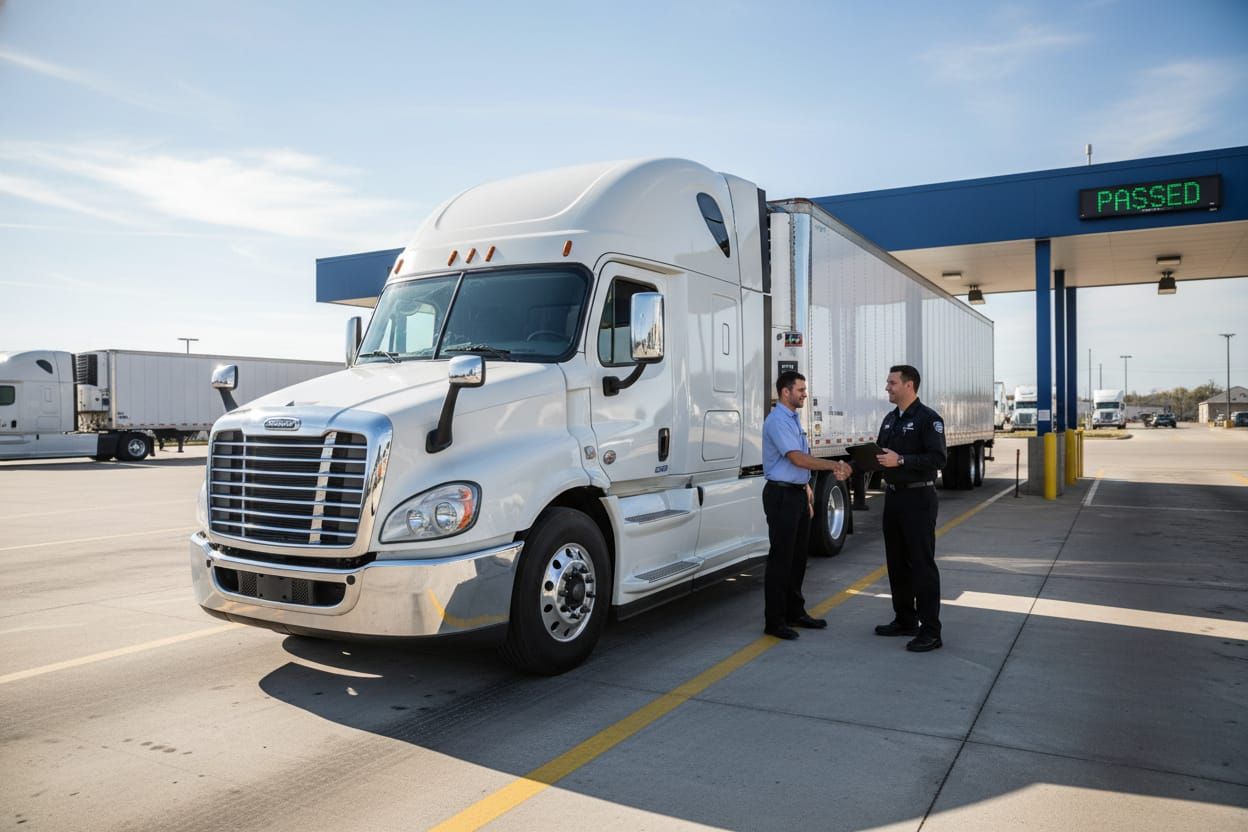
What Is a DOT Inspection?
A DOT inspection is an examination of your vehicle, cargo, and/or driver credentials by a certified FMCSA inspector. They happen at weigh stations, roadside stops, and sometimes your terminal. In 2024, FMCSA conducted over 3.5 million inspections — so this isn’t hypothetical. It’s when, not if.
3.5M+ Inspections per year
21% Result in OOS violations
Level I Most common type
Out-of-Service (OOS) means your truck or you cannot continue driving until the violation is corrected. About 1 in 5 inspections result in at least one OOS violation — most commonly brake and tire issues.
The 6 Inspection Levels
Not all inspections are created equal. FMCSA defines six levels, each with different scopes. Here’s what to expect from each:
Level I North American Standard
The full inspection. Everything gets checked — driver and vehicle. Takes 45-90 minutes.
What They Check:
- Driver’s license, medical card, endorsements
- Record of duty status (ELD/logbook)
- Hours of Service compliance
- Vehicle registration, insurance (MCS-90/BMC-91)
- Brake system — under-vehicle crawl inspection
- Tires, wheels, rims, hubs
- Steering, suspension, frame
- Exhaust, fuel system, coupling devices
- Lights, reflectors, electrical
- Cargo securement (if applicable)
- Hazmat (if applicable)
~32% of all inspections
Level II Walk-Around Driver/Vehicle
Same as Level I but without going under the vehicle. Inspector walks around and checks what’s visible. Takes 30-45 minutes.
What They Check:
- All driver credentials
- HOS and ELD
- Everything visible without crawling under
- Brake adjustment (push-rod stroke visible)
- Tires, lights, fluid leaks
~46% of all inspections (most common)
Level III Driver-Only
Driver credentials only. No vehicle inspection. Takes 15-20 minutes.
What They Check:
- CDL, medical certificate, endorsements
- Record of duty status / ELD
- Hours of Service compliance
- Seatbelt use
- Drug/alcohol screening (if reasonable suspicion)
~18% of all inspections
Level IV Special Inspections
One-time examination of a specific item. Often used for research or targeted enforcement campaigns.
Rare — typically part of special programs
Level V Vehicle-Only (Without Driver)
Full vehicle inspection at a location where the vehicle can be examined without the driver. Terminal inspections.
Uncommon — usually terminal audits
Level VI Enhanced NAS for Radioactive
Level I plus radiological-specific checks. Only for vehicles carrying highway-route-controlled quantities of radioactive materials.
Very rare — specialized hazmat only
What Triggers an Inspection?
Inspections aren’t random. Understanding the triggers helps you avoid unwanted attention.
Your ISS Score
FMCSA’s Inspection Selection System (ISS) assigns a score of 1-100 to every vehicle passing through a weigh station. Higher score = higher priority for inspection. Scores are based on your carrier’s safety record, BASIC scores, and recent inspection history.
Visual Cues
Inspectors notice: visible damage, fluid leaks, excessive smoke, missing lights, unsecured cargo, improperly displayed placards, expired registration stickers, and how you act when pulling in.
Blitzes & Campaigns
CVSA runs targeted enforcement campaigns like International Roadcheck (June, 72-hour blitz), Brake Safety Week (August), and Operation Safe Driver Week (July). During these, inspection rates spike dramatically.
Complaints & Tips
Public complaints about erratic driving, unsafe equipment, or illegal operations can flag your DOT number. Competitor complaints happen too.
New Authority Status
New entrant carriers (first 18 months) get extra scrutiny. FMCSA tracks you through the New Entrant Safety Assurance Program — expect a safety audit within 18 months.
GPS/ELD Anomalies
Some states use PrePass and Drivewyze data to flag vehicles for inspection based on travel patterns or HOS anomalies detected electronically.
The Paperwork You Need — Ready to Hand Over
When an inspector walks up, they expect these documents immediately. Fumbling around makes a bad impression and can extend the inspection.
Driver Documents
- CDL — Valid, correct class, proper endorsements (H, N, T, X, P, S)
- Medical Examiner’s Certificate — Current (max 2 years, or 1 year for some conditions)
- Skill Performance Evaluation — If you have a vision or hearing waiver
- Record of Duty Status — Current day + previous 7 days (ELD or paper backup)
- ELD User Manual — Must be accessible (digital counts)
- ELD Instruction Sheet — For the inspector, showing how to access data
Vehicle Documents
- Vehicle Registration — Current for truck and trailer
- Proof of Insurance — MCS-90 endorsement or BMC-91 proof
- IFTA Sticker & License — If crossing state lines (quarterly fuel tax)
- IRP Cab Card — Apportioned registration for interstate carriers
- Annual Vehicle Inspection Report — Periodic inspection (good for 14 months)
- DVIR — Driver Vehicle Inspection Report (pre-trip / post-trip)
Cargo Documents (If Loaded)
- Bill of Lading — Accurate description, weight, shipper/consignee info
- Hazmat Shipping Papers — Within arm’s reach, proper format (if hazmat)
- Emergency Response Info — ERG guide or shipper’s emergency contact (if hazmat)
Pro Tip: The Document Folder
Keep a dedicated folder or clipboard in your cab with everything organized and tabbed. When the inspector asks for documents, hand them the whole folder. This signals you’re professional and prepared — and inspectors tend to go easier on drivers who clearly take compliance seriously.
Most Common Violations (And What They Cost)
Not all violations are equal. Some are fixable roadside; others put you Out of Service. Here are the violations inspectors find most often:
| Violation | Severity | OOS? | Fine Range |
|---|---|---|---|
| Brake adjustment / components | Critical | Yes | $1,000 - $7,000 |
| Hours of Service violations | Critical | Yes | $1,000 - $16,000 |
| No valid medical certificate | Critical | Yes | $1,000 - $2,750 |
| Tire tread depth / condition | Serious | Often | $500 - $2,500 |
| Lights/reflectors inoperative | Moderate | Sometimes | $250 - $1,000 |
| Cargo securement deficiencies | Serious | Often | $500 - $5,000 |
| Form/manner of RODS (logbook) | Moderate | Rarely | $250 - $1,000 |
| No/expired fire extinguisher | Minor | No | $100 - $500 |
| No/expired reflective triangles | Minor | No | $100 - $500 |
The CSA Connection
Every violation goes into FMCSA’s CSA (Compliance, Safety, Accountability) system and affects your BASIC scores. High BASIC scores trigger Warning Letters, Investigations, and can affect your insurance rates. Violations stay in the system for 24 months. Clean inspections help — they count as a positive data point.
Your Rights During an Inspection
You have rights. Most drivers don’t know them. Here’s what you’re entitled to:
Right to Observe
You can watch the entire inspection. Walk with the inspector. Ask questions about what they’re checking. This isn’t confrontational — it’s professional.
Right to a Copy
You must receive a copy of the inspection report (form MCS-63 or electronic equivalent). Review it before you sign. Check every item.
Right to Challenge
You can request a DataQs challenge if you believe a violation is incorrect. This goes through FMCSA’s online system and can result in the violation being removed from your record.
Right to Refuse Search
Inspectors can examine safety-related items. They cannot search your cab, personal belongings, or sealed cargo without your consent or a warrant. A DOT inspection is not a law enforcement search.
Right to Fair Treatment
Inspectors must be CVSA-certified. They must follow standard procedures. If you feel an inspection was conducted improperly, note the inspector’s name and badge number and file a complaint with the state agency.
Right to Fix & Continue
For many violations, you can make repairs on the spot and continue driving. The inspector notes the violation but also notes it was corrected. For OOS violations, you must fix the issue before moving the vehicle.
How to Behave During an Inspection
Your attitude matters more than you think. Inspectors have discretion. Here’s how to use that to your advantage:
Do
- Be calm and professional. Greet the inspector. Be courteous.
- Have documents ready. Hand over the folder before they ask.
- Exit the cab if asked. Follow instructions promptly.
- Walk with them. Show interest in your vehicle’s condition.
- Ask questions respectfully. “Can you show me what you’re seeing?” is fine.
- Take notes. Write down anything flagged so you can address it.
- Thank them when it’s over. Professionalism is remembered.
Don’t
- Don’t argue or get confrontational. Fight it through DataQs later, not roadside.
- Don’t lie about anything. If your brakes are worn, they’ll see it. Lying destroys credibility.
- Don’t offer excuses. “I was going to fix that” doesn’t help. State facts only.
- Don’t call your dispatcher mid-inspection. Focus on the inspector.
- Don’t refuse a lawful inspection. Refusal is itself a violation and guarantees a full Level I.
- Don’t sign without reading. Review the report. Note any disagreements.
The Complete Timeline: Before, During, After
Before: Preparation
1
Pre-trip inspection every single time
Check brakes (push-rod stroke), tires (tread depth, pressure, damage), lights (all 12+ required), fluid levels, coupling devices, mirrors. Document it in your DVIR.
2
Organize your documents
Everything in one folder: CDL, med card, registration, insurance, IFTA, IRP, annual inspection. Check expiration dates monthly.
3
Keep your ELD current
No unidentified driving time. Proper annotations. Know how to do a data transfer (USB, Bluetooth, email) — inspectors will ask.
4
Check your CSA scores
Review your BASIC scores at ai.fmcsa.dot.gov. Challenge incorrect violations via DataQs. Know where you stand before an inspector tells you.
During: The Inspection
5
Pull in safely and park properly
Follow weigh station instructions. Park where directed. Set parking brake. Engine off (unless asked to keep running for brake test).
6
Present documents promptly
Have your document folder ready. Answer questions honestly and concisely. Don’t volunteer unnecessary information.
7
Observe and take notes
Walk with the inspector if allowed. Note anything flagged. Ask for clarification on anything you don’t understand.
8
Review the report before signing
Read every line. Your signature acknowledges receipt — not agreement. Note any items you plan to dispute.
After: Follow-Up
9
Fix violations immediately
Don’t wait. Correct any vehicle defects. For OOS violations, have repairs documented by a qualified mechanic with receipts.
10
Notify your carrier/insurer
Report the inspection to your motor carrier (even if you’re an O/O — document it). Serious violations may need to be reported to your insurance agent.
11
Challenge incorrect violations
Use DataQs (dataqs.fmcsa.dot.gov) within 90 days. Provide evidence: repair receipts, photos, maintenance records. Successful challenges remove violations from your CSA scores.
12
Learn from it
What was flagged? Add those items to your pre-trip routine. A clean inspection is actually good for your CSA — it’s a positive data point.
How Inspections Affect Your Insurance
This is where DOT inspections hit your wallet — sometimes years after the fact.
What Hurts Your Rates
- OOS violations — especially brake and driver-related. Carriers see these as high-risk indicators.
- High CSA BASIC scores — insurance underwriters check these. Scores above thresholds trigger surcharges or non-renewal.
- Pattern of violations — one bad inspection is explainable. Three in a year is a trend.
- HOS violations — fatigue-related violations correlate strongly with accident risk, and insurers know it.
- Hazmat violations — any hazmat-related OOS can trigger significant premium increases.
What Helps Your Rates
- Clean inspections — no violations = positive CSA data point. Actively lowers your risk score.
- High inspection frequency with clean results — shows you’re consistently maintaining your equipment.
- Quick violation correction — documented repairs within 15 days show responsibility.
- Successful DataQs challenges — removing incorrect violations cleans your record.
- Consistent pre-trip documentation — DVIRs show you take maintenance seriously.
The Insurance Renewal Reality
When your policy comes up for renewal, your underwriter pulls your ISS score, CSA BASICs, and inspection history. Two OOS violations in a year can mean a 15-30% rate increase. A pattern of clean inspections can earn you preferred rates — some carriers offer 5-10% discounts for clean CSA records. Your pre-trip inspection isn’t just compliance — it’s a financial investment.
How to Challenge a Violation (DataQs Process)
If you believe a violation was incorrectly recorded, you can challenge it. Here’s how:
1
Go to dataqs.fmcsa.dot.gov
Create an account if you don’t have one. You need your DOT number.
2
Select “Request a Data Review” (RDR)
Choose the inspection report you want to challenge. You’ll need the inspection report number.
3
Provide evidence
Upload documentation: repair receipts dated before the inspection, calibration records, photos showing the condition at the time, or maintenance logs proving compliance.
4
Wait for state review
The state that issued the inspection reviews your challenge. This typically takes 30-90 days. You can check status online.
5
Appeal if denied
If the state denies your challenge, you can appeal to FMCSA directly. Provide additional evidence if available.
Best Chances of Success
DataQs challenges succeed most often when you have timestamped evidence from before the inspection: dated repair receipts, calibration records, or photos. “I fixed it after” doesn’t remove the violation — “it was already compliant” does. Keep your maintenance records organized.
Annual CVSA Enforcement Events
Mark these on your calendar. Inspection rates spike dramatically during these enforcement campaigns.
June
International Roadcheck
The big one. 72-hour blitz across North America. Inspectors at every major weigh station conducting Level I and Level III inspections. In 2024, over 40,000 inspections in 3 days. Annual focus area rotates (hours of service, cargo securement, etc.).
July
Operation Safe Driver Week
Focused on driver behaviors: speeding, distracted driving, failure to use seatbelts, following too closely. Law enforcement looks for moving violations specifically.
August
Brake Safety Week
Targeted brake inspections. Inspectors check brake adjustment, components, and ABS systems. In 2024, 12% of vehicles inspected were placed OOS for brake violations.
November
Hazmat Safety Week
Focused on hazmat carriers: placarding, shipping papers, packaging, and hazmat endorsements. Even non-hazmat carriers may be inspected during this period.
Frequently Asked Questions
Can I refuse a DOT inspection?
Technically you can, but it’s a terrible idea. Refusal to submit to an inspection is itself a violation under 49 CFR 392.9, and it virtually guarantees a full Level I inspection plus potential penalties. You can, however, refuse a search of your personal belongings or unsealed non-cargo areas — that’s different from refusing the inspection itself.
Do clean inspections actually help my CSA scores?
Yes. Clean inspections (no violations) are recorded as a positive data point in the FMCSA SAFER system. They don’t directly reduce existing violation scores, but they improve your overall safety record, can help lower your ISS score (meaning fewer future inspections), and are viewed favorably by insurance underwriters at renewal time.
How long do violations stay on my record?
Violations remain in the CSA system for 24 months from the date of the inspection. More recent violations are weighted more heavily than older ones. After 24 months, they drop off your BASIC scores, though the inspection itself remains in the FMCSA database permanently.
What happens if I’m placed Out of Service?
You cannot move your vehicle (for vehicle OOS) or drive (for driver OOS) until the violation is corrected. For vehicle issues, you may need a mobile mechanic or tow. For driver issues (like HOS), you typically need to wait until you’re back in compliance. OOS violations also go on your record and can trigger follow-up investigations from FMCSA. Always have your insurance agent’s number handy — some violations may need to be reported to your carrier.
Should I report every inspection to my insurance agent?
Report any inspection that results in OOS violations or significant findings. Clean inspections don’t need to be reported but documenting them helps at renewal time — keep copies. If you’re unsure whether something should be reported, call your agent and ask. It’s always better to disclose than to have your insurer discover it during underwriting.
Related Tools
Free Tool Pre-Trip Inspection Guide Interactive checklist covering every DOT inspection point so you pass Level 1 inspections. Free Tool DOT Audit Self-Check Run a self-audit to ensure your compliance records are ready if inspections trigger a review. Free Tool Compliance Calendar Never miss an inspection follow-up deadline or compliance filing date.
Worried About How Inspections Affect Your Insurance?
We help truckers understand their CSA scores, manage their risk profile, and find coverage that accounts for their actual safety record — not just their violation count. Call us for a straight answer.