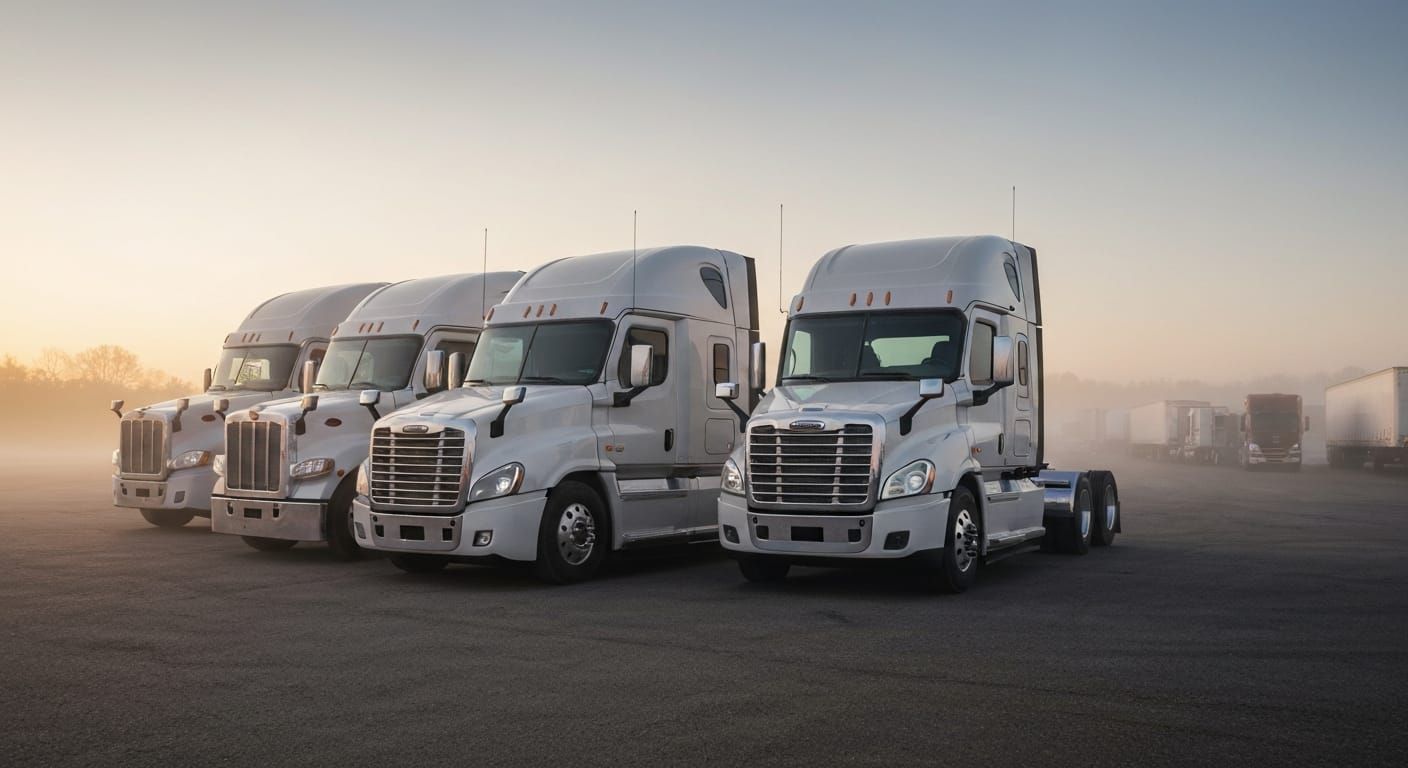
The 4 Growth Stages
Every fleet goes through predictable stages. Each one has different challenges, and what worked at one stage often breaks at the next:
1 Solo (1 Truck)
Focus: Survival
- You are the driver, dispatcher, mechanic, and bookkeeper
- Revenue depends entirely on your driving hours
- Insurance is straightforward: one truck, one driver
- Key challenge: Building cash reserves while paying bills
Typical gross: $150K-$250K/year
2 Small Fleet (2-5 Trucks)
Focus: Systems
- First time managing other drivers
- Need maintenance scheduling for multiple trucks
- Insurance gets more complex: multiple drivers, fleet policy
- Key challenge: You can’t do everything yourself anymore
Typical gross: $400K-$1.2M/year
3 Growing Fleet (6-15 Trucks)
Focus: Delegation
- Need a dispatcher (or dispatch service)
- Compliance becomes a full-time job (DQ files, drug testing, etc.)
- Insurance discounts become available (fleet rates)
- Key challenge: Hiring quality drivers at scale
Typical gross: $1.2M-$3.5M/year
4 Established Fleet (16+ Trucks)
Focus: Optimization
- Dedicated office staff (dispatch, safety, accounting)
- Fleet management software becomes essential
- Can negotiate better insurance rates and terms
- Key challenge: Maintaining quality as you scale
Typical gross: $3.5M+/year
When to Add Your Next Truck
Adding a truck too early is the #1 fleet killer. You need to pass ALL of these tests before buying truck #2 (or #3, or #10):
$
Financial Readiness
You have 3-6 months of operating expenses in cash reserves. Not revenue — cash in the bank that could cover all bills if no loads came in for 3 months. For most operations, this means $30,000-$60,000 liquid.
D
Demand Exceeds Capacity
You’re regularly turning down loads because your truck is committed. You have consistent freight — not one good month. Look for at least 6 months of steady, profitable loads before concluding you need more capacity.
P
Driver Pipeline Exists
You have a qualified driver identified — or a reliable source of drivers. Buying a truck without a driver means it sits and bleeds money. A truck payment + insurance with zero revenue is $3,000-5,000/month in losses.
S
Systems Are Working
Your current operation runs smoothly. Maintenance is scheduled, compliance is current, bookkeeping is organized. If your one-truck operation is chaotic, adding a second truck will make it worse, not better.
I
Insurance Is Scalable
Talk to your agent BEFORE buying. Some policies don’t easily add vehicles. Some insurers won’t cover fleets. You need to know your per-truck cost and whether adding a truck (and driver) will trigger a rate change.
The $3,000/Month Mistake
A truck sitting with no driver or no loads costs roughly: $1,500 truck payment + $800 insurance + $200 registration/permits + $300 maintenance reserves + $200 parking = $3,000/month minimum. That’s $36,000/year bleeding out before the truck earns a dollar. Never buy a truck hoping you’ll find a driver later.
Fleet Cost Tracking
You can’t manage what you don’t measure. Track these numbers PER TRUCK, not just fleet-wide:
Revenue Per Truck
Gross revenue $12,000-18,000/mo
Revenue per mile $2.50-3.50/mi
Utilization rate 85-92%
Deadhead percentage <15%
Cost Per Truck
Fuel 30-35% of revenue
Driver pay 25-35% of revenue
Insurance 8-15% of revenue
Truck payment 10-15% of revenue
Maintenance 5-10% of revenue
Profit Per Truck
Target net margin 5-12%
Breakeven miles/month 6,000-8,000
Net profit per truck $800-2,000/mo
If any truck consistently loses money after 90 days of trying, it’s a problem truck — fix the issue or remove it from the fleet.
Fleet Maintenance Scheduling
Maintenance is the difference between a truck that makes money and a truck that drains it. For fleets, you need a system — not just fixing things when they break.
| Service | Interval | Avg Cost | If Skipped |
|---|---|---|---|
| Oil & filter change | Every 15,000-25,000 mi | $300-500 | Engine failure: $15,000-30,000 |
| Tire rotation/replacement | Every 50,000-80,000 mi | $400-600/tire | Blowout + tow: $3,000-5,000 |
| Brake inspection/adjustment | Every 30,000-50,000 mi | $200-800 | OOS violation + brake failure risk |
| DPF cleaning | Every 200,000-300,000 mi | $300-600 | DPF replacement: $3,000-5,000 |
| Coolant flush | Every 300,000 mi or 5 years | $150-300 | Overheating, engine damage |
| Transmission service | Every 100,000-150,000 mi | $300-500 | Transmission rebuild: $5,000-10,000 |
| Annual DOT inspection | Every 12 months | $100-200 | Fines + OOS if expired |
Fleet Maintenance Best Practices
Track by Truck, Not by Fleet
Each truck has different mileage, age, and history. A 2020 with 400K miles needs different care than a 2024 with 80K. Track maintenance schedules individually.
Budget $0.15-0.20/mile for Maintenance
Set aside this amount per loaded mile into a maintenance reserve. A truck running 10,000 miles/month should reserve $1,500-2,000/month for maintenance.
Use DVIR Data
Your drivers do pre-trip inspections daily. Review their DVIRs weekly. Patterns in driver reports (same brake issue on truck #3 three weeks in a row) catch problems before they become breakdowns.
Build Mechanic Relationships
Find a reliable shop near your base and build a relationship. Fleet customers get priority scheduling, better rates, and mechanics who know your trucks’ history.
Fleet Insurance: How It Changes as You Grow
Insurance is one of your biggest costs — and it changes significantly as you add trucks and drivers. Here’s what to expect at each stage:
1 Truck
Policy type Individual commercial auto
Annual premium $8,000-15,000
Key factor Your personal driving record and CDL experience
2-5 Trucks
Policy type Small fleet policy
Annual premium $18,000-60,000 (fleet total)
Key factor Combined driving records of ALL drivers. One bad driver raises rates for entire fleet.
Note Must list every driver. Add new drivers BEFORE they start driving.
6-15 Trucks
Policy type Fleet policy with possible loss-sensitive pricing
Annual premium $55,000-180,000
Key factor Claims history becomes dominant. Your loss ratio determines renewal pricing.
Opportunity Fleet safety programs can earn discounts. Dash cams, safety training, and driver scorecards reduce premiums.
16+ Trucks
Policy type Large fleet with deductible programs or self-insured retention
Annual premium $180,000+
Key factor Safety culture, loss control programs, and management capabilities.
Opportunity Higher deductibles trade lower premiums for more risk. Only works with strong cash reserves and safety programs.
Talk to Your Agent Before Adding Trucks
Adding a truck isn’t just a phone call to add a vehicle. Your insurer will evaluate the new driver, the truck’s age and condition, and how it changes your fleet profile. Some additions require re-underwriting. Get a quote for the added truck BEFORE you buy it — so there are no surprises. Our rate negotiation guide covers how to get the best fleet pricing.
Fleet Management Tools
As your fleet grows past 3-4 trucks, spreadsheets stop working. Here’s what fleet management software should handle:
Dispatch & Load Management
Assign loads to trucks, track status, manage driver schedules. At 5+ trucks, you need real-time visibility into where every truck is and what it’s doing.
Maintenance Tracking
Automated reminders for oil changes, inspections, tire replacements. Track costs per truck. Some systems integrate with ELDs for mileage-based triggers.
Compliance Management
DQ file tracking, medical card expiration alerts, annual MVR reminders, drug testing schedules, ELD monitoring. Missing one compliance item can cost thousands.
Accounting & Cost Tracking
Revenue and expenses per truck. Profit margins. Driver settlements. IFTA fuel tax calculations. Quarterly estimated tax tracking.
Driver Communication
Messaging, document sharing (BOLs, rate confirmations), DVIR submission. Reduces phone calls and keeps everything documented.
Safety & Dash Cams
Event-triggered recording, driver scorecards, coaching tools. Insurance companies increasingly offer discounts (5-15%) for dash cam programs.
6 Fleet Scaling Mistakes
1
Growing Too Fast
Adding 3 trucks in 6 months when you’ve never managed a driver before. Growth should be sequential — add one truck, stabilize, learn, then add another. The carriers that survive grow by 1-2 trucks per year, not 5.
2
Not Tracking Per-Truck Profitability
Your fleet makes money overall, so everything seems fine. But truck #3 has been losing $1,200/month for 6 months because the driver takes bad loads and the truck needs constant repairs. You don’t know because you only track fleet totals.
3
Hiring Bodies Instead of Drivers
You need a driver so badly that you lower your standards. “He has a couple of violations, but he can start Monday.” Three months later, he causes an accident that costs your fleet $50,000 in insurance increases over 3 years. See our driver hiring guide for the proper process.
4
Buying Cheap Trucks
A $25,000 used truck with 600K miles seems like a deal. Then you spend $15,000 in repairs the first year, lose revenue to breakdowns, and get DOT violations for mechanical defects. Total cost: more than a newer truck with a payment.
5
No Cash Reserves
Using every dollar to make truck payments, leaving nothing for emergencies. One engine failure, one accident deductible, one slow freight month — and you can’t make payroll. Keep 3-6 months of operating expenses in reserve.
6
Ignoring Compliance Until the Audit
DQ files, drug testing, vehicle maintenance records — they’re not paperwork for paperwork’s sake. They’re what prevents FMCSA from shutting you down. Build compliance into your daily operations, not as an afterthought. See our authority revocation guide for what’s at stake.
Frequently Asked Questions
How many trucks do I need before I stop driving myself?
Most fleet owners stop driving full-time around 4-6 trucks. At that point, managing drivers, dispatching, maintenance, and compliance becomes a full-time job. Some owners keep driving part-time (filling in for vacations or covering a truck when they’re between drivers) even with 10+ trucks. The key is whether your time generates more value driving or managing.
Should I buy or lease trucks for my fleet?
Both work, but for different situations. Buying builds equity and gives you flexibility. Leasing preserves cash and often includes maintenance. For fleet scaling, many carriers use a mix: buy their first 2-3 trucks, then lease additional trucks to test demand before committing to purchase. See our lease vs buy guide for the full financial comparison.
What’s a good profit margin for a small fleet?
A healthy small fleet (5-10 trucks) should target 5-12% net profit margin after all expenses including owner compensation. At $200K gross revenue per truck per year with a 5-truck fleet ($1M gross), that’s $50,000-120,000 in net profit. Margins above 12% are excellent. Below 5%, you’re one bad month from trouble.
Do I need a safety director for my fleet?
FMCSA doesn’t require a named “safety director,” but someone in your organization must be responsible for compliance. At 1-5 trucks, that’s usually you. At 6-15 trucks, consider a part-time safety consultant. At 15+ trucks, a full-time safety manager pays for itself through reduced violations, better insurance rates, and accident prevention. Some insurers offer premium discounts for fleets with dedicated safety personnel.
Fleet Insurance That Scales With You
Whether you’re adding truck #2 or truck #20, we build insurance programs that grow with your fleet. Per-truck pricing, driver management support, and competitive fleet rates from carriers who understand small fleets.