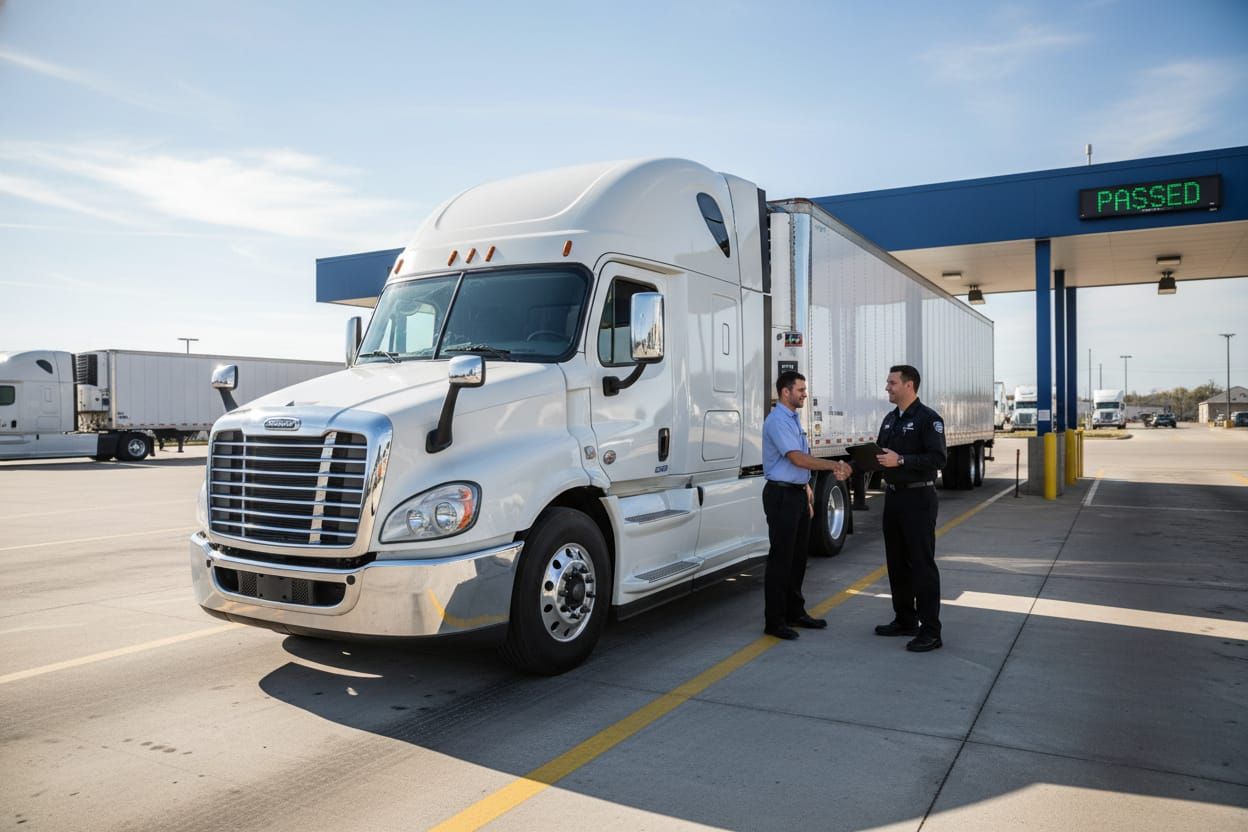
The hard truth about new carrier compliance: FMCSA doesn’t chase you down with reminders. Miss a filing, let your insurance lapse, skip your safety audit — and your authority gets revoked. Sometimes within days. This guide exists so you know every requirement before it bites you.
The Compliance Landscape
New motor carriers face a layered compliance framework. Federal requirements come from FMCSA (Federal Motor Carrier Safety Administration), part of the U.S. Department of Transportation. State requirements layer on top. And contractual requirements from brokers and shippers can be stricter than federal law.
Here’s how the layers work:
1
Federal — FMCSA
Registration, authority, insurance filings, safety programs, driver qualifications, hours of service, vehicle inspections.
2
Federal — Other
IRS (EIN, IFTA), DOT hazmat rules (PHMSA), customs if crossing borders.
3
State Requirements
UCR (Unified Carrier Registration), state operating permits, IRP (International Registration Plan), state fuel tax.
4
Contractual
Broker requirements, shipper requirements, lease agreements — often stricter than federal minimums.
This guide focuses on federal FMCSA requirements because those are the ones that can immediately kill your operating authority. State and contractual requirements are covered where relevant.
18
Months FMCSA monitors new carriers
12
Months to complete safety audit
$16,000
Max fine per violation per day
30
Days insurance lapse before revocation
USDOT Number & MC Operating Authority
Before any truck moves in interstate commerce, you need two things from FMCSA: a USDOT number and, for for-hire carriers, an MC number (operating authority).
USDOT Number
The USDOT number is your federal identifier. It’s required for:
- Commercial vehicles over 10,001 lbs operating in interstate commerce
- Vehicles transporting hazardous materials in interstate or intrastate commerce
- Vehicles designed to transport 9 or more passengers (including the driver) for compensation, or 16+ passengers not for compensation
Many states also require a USDOT number for intrastate commercial operations — check your state’s requirements separately.
How to apply
Apply through FMCSA’s FMCSA Registration (formerly Unified Registration System) at safer.fmcsa.dot.gov. The USDOT number itself is free — costs come when you apply for operating authority. Use our DOT lookup tool to verify any carrier’s USDOT status.
Biennial update requirement: All USDOT registrations must be updated every two years. FMCSA will mark your number inactive if you miss the update, which can suspend your authority. Set a calendar reminder — FMCSA sends reminders but they go to email addresses that change.
MC Number (Operating Authority)
For-hire carriers moving regulated commodities in interstate commerce need an MC number in addition to a USDOT number. “For-hire” means you’re hauling freight for others in exchange for compensation. Private carriers (hauling your own goods) don’t need an MC number.
Applying for MC authority:
- Submit application through FMCSA’s registration system. Fee: $300 per authority type.
- 10-day protest period — competitors can protest your application (rare but possible).
- Authority granted — but not yet active. You still need BOC-3 and insurance on file.
- Authority activates — once FMCSA confirms your BOC-3 and insurance filings are in order.
Total timeline: typically 20-30 business days from application to active authority, assuming no protests and prompt filing of BOC-3 and insurance.
Common mistake
Many new carriers schedule their first load while waiting for authority, expecting it to arrive by a specific date. Don’t. The timeline is an estimate, not a guarantee. Do not commit to a load until your authority shows “Active” in FMCSA’s system.
Insurance Requirements for New Motor Carriers
FMCSA insurance requirements are non-negotiable. Let your coverage lapse and FMCSA will revoke your operating authority — often within days. Here’s what you need.
Minimum Liability Coverage
Required liability minimums under 49 CFR Part 387:
| Operation Type | Vehicle Weight | Minimum Coverage |
|---|---|---|
| General Freight (non-hazmat) | 10,001–26,000 lbs | $300,000 |
| General Freight (non-hazmat) | 26,001+ lbs | $750,000 |
| Household Goods | 10,001+ lbs | $750,000 |
| Oil (large quantities) | 10,001+ lbs | $1,000,000 |
| Hazardous Materials (general) | 10,001+ lbs | $1,000,000 |
| Hazmat — Poison, Compressed Gas, Explosives | Any | $5,000,000 |
These are federal minimums. In practice, most freight brokers require $1,000,000 in auto liability regardless of what you haul or how heavy your truck is. If you’re targeting broker loads — which most new carriers are — get $1,000,000 from day one.
How Insurance Gets Filed with FMCSA
You don’t file insurance directly. Your insurance company files on your behalf using standardized FMCSA forms:
BMC-91 / BMC-91X
What it is: Proof of liability insurance filed electronically by your insurer with FMCSA.
BMC-91: For most trucking operations.
BMC-91X: For carriers who self-insure or use a surety bond in place of commercial insurance.
When filed: Your insurer files when your policy is bound. FMCSA must show active insurance before your authority can activate.
MCS-90 Endorsement
What it is: A mandatory endorsement on your policy that guarantees the public will be compensated for injury or property damage — even if the policy has an exclusion that would otherwise apply.
Who it protects: Third parties, not you.
Practical effect: If your insurer has to pay out under MCS-90, they can come back and sue you to recover those funds. The MCS-90 doesn’t add coverage — it eliminates certain policy defenses against public claims.
What Happens When Insurance Lapses
If your insurer cancels or non-renews your policy, they’re required to file a notice with FMCSA. FMCSA then has the authority to revoke your operating authority immediately. Most carriers have a 35-day advance notice from their insurer before this happens — but FMCSA moves fast once a lapse is recorded.
Reinstatement after revocation requires proof of new insurance, a reinstatement application, and a fee. The process can take weeks, during which you cannot legally operate. Your insurance agent should be watching your policy status — make sure yours is.
Cargo insurance — not federally required, but practically mandatory
FMCSA doesn’t require cargo insurance for most carriers (household goods carriers are the exception). But almost every broker requires it. Standard minimum: $100,000. Refrigerated cargo and high-value freight may require $250,000+. If you can’t get loads without cargo insurance, you need cargo insurance.
BOC-3 Process Agent Filing
The BOC-3 is one of the simplest requirements and one of the most commonly overlooked by new carriers.
What It Is
A BOC-3 designates a “process agent” — a person or business authorized to accept legal service of process on your behalf — in each state where you operate. If someone sues you and can’t find you to serve the lawsuit, they can serve your process agent instead. FMCSA requires this because carriers operate across state lines and shouldn’t be able to dodge lawsuits by being hard to locate.
Why It’s Required Before Your Authority Activates
Unlike most compliance requirements that start after you begin operations, the BOC-3 must be on file with FMCSA before your operating authority activates. FMCSA won’t flip your status from “pending” to “active” without it.
How to Get a BOC-3 Filed
Almost no one designates process agents state-by-state themselves. The standard approach is to use a blanket BOC-3 filing service — companies that already have agents in every state and file the paperwork electronically with FMCSA on your behalf.
| Option | Cost | Time | Notes |
|---|---|---|---|
| Blanket BOC-3 service | $25–$60 one-time | 24–48 hours | Most common. Covers all 50 states + DC. File direct at FMCSA portal. |
| Designate your own agents | Variable (each state) | Days to weeks | Impractical for most carriers. Only relevant if you only operate in 1–2 states. |
| Through a transport attorney | $100–$300+ | 2–5 days | Makes sense if you need legal guidance along with the filing. |
The BOC-3 doesn’t expire or require renewal as long as your process agents remain active. Some services charge an annual maintenance fee — others are truly one-time. Confirm which you’re signing up for.
UCR — Unified Carrier Registration
UCR is an annual registration program administered by a consortium of states. If you operate in interstate commerce, you’re required to register and pay an annual fee based on your fleet size.
Who Needs UCR
You need UCR if you’re a:
- Motor carrier operating in interstate commerce
- Freight broker
- Leasing company
- Freight forwarder
Even if your state doesn’t enforce UCR, you still need it to operate in participating states. Most states participate. A few — including Arizona, Florida, Hawaii, Nevada, New Jersey, Oregon, and Vermont — don’t participate in collection but carriers in those states still owe UCR fees if they operate in other states.
UCR Fees (2026)
| Fleet Size | Annual UCR Fee |
|---|---|
| 0 vehicles (brokers/forwarders) | $76 |
| 1–2 vehicles | $76 |
| 3–5 vehicles | $227 |
| 6–20 vehicles | $452 |
| 21–100 vehicles | $1,356 |
| 101–1,000 vehicles | $6,782 |
Fees are subject to annual adjustment. Verify current rates at ucr.gov before registering.
When to Register
UCR registration opens each fall for the following year. New carriers should register as soon as they receive operating authority — you may be liable for UCR fees from the date your authority activates, not just from when you start hauling.
Operating without current UCR registration can result in fines up to $100 per day in participating states. Officers at weigh stations and checkpoints can verify your UCR status electronically.
The New Entrant Safety Audit
Every new motor carrier is subject to a New Entrant Safety Audit within 12 months of receiving operating authority. This is FMCSA’s way of verifying that new carriers know the rules and are following them before giving them a clean bill of health.
What FMCSA Reviews
The audit examines six compliance areas:
1. Controlled Substances & Alcohol Testing
You must have a drug and alcohol testing program in place before your first driver operates a commercial vehicle. This includes pre-employment testing, random testing, post-accident testing, and return-to-duty procedures. Your program must comply with 49 CFR Part 382.
2. Driver Qualifications
Every driver must have a current Driver Qualification (DQ) file. This includes a valid CDL (if required), medical certificate (DOT physical), employment application, motor vehicle record check, road test certificate or equivalent, and annual review of driving record.
3. Hours of Service (HOS)
Drivers must comply with federal hours of service regulations. With the ELD mandate in effect, most carriers need Electronic Logging Devices. Records of Duty Status (RODS) must be maintained and available for inspection.
4. Vehicle Inspection, Repair & Maintenance
Vehicles must pass pre-trip inspections (documented), and systematic inspection, repair, and maintenance records must be kept. Annual inspections are required — each vehicle must have a current annual inspection sticker or documentation.
5. Accident Register
You must maintain a log of all accidents meeting the DOT reportable threshold — fatalities, injuries requiring immediate medical treatment, or vehicle towed from the scene. The register must be kept for 3 years.
6. Financial Responsibility
Proof that current FMCSA insurance filings are active and meet minimums. This is usually confirmed by FMCSA’s own records, but be prepared to show your policy documents and confirm your BMC-91 is on file.
Pass or Fail
The new entrant audit is pass/fail. FMCSA rates carriers on “acute” and “critical” violations:
- Acute violations — serious violations that require immediate corrective action (examples: allowing a driver to operate while impaired, no drug testing program in place)
- Critical violations — systemic failures in required compliance programs
A certain combination of violations — particularly in controlled substances, driver fitness, or vehicle maintenance — triggers an “unsatisfactory” rating. FMCSA then issues a Notice to Remedy, giving you 60 days to fix deficiencies. If you don’t, your authority is revoked.
Most audit failures come from paperwork, not dangerous operations
The majority of new entrant audits that end in revocation fail because of missing or incomplete records — no DQ files, no drug testing program documentation, no maintenance records — not because carriers were actually operating unsafely. Get your paperwork right from day one. You can’t backfill records after an audit notice arrives.
Preparing for Your Audit
Use our New Authority Compliance Checklist to verify your records are in order. You can also check what FMCSA already has on file for your DOT number using our DOT Lookup Tool. FMCSA will typically give you 48-hour notice before an audit — which is not enough time to build a compliance program from scratch.
Build the programs now. It costs more in time upfront but protects the authority you spent money and weeks to get.
CSA Scores: How FMCSA Measures Your Safety Performance
CSA — Compliance, Safety, Accountability — is FMCSA’s ongoing safety measurement system. Unlike the new entrant audit (a one-time event), CSA scoring is continuous. Every roadside inspection, violation, and reportable accident feeds into your CSA scores for the next 24 months.
The Seven BASICs
CSA measures performance across seven Behavior Analysis and Safety Improvement Categories (BASICs):
1
Unsafe Driving
Speeding, reckless driving, improper lane changes, inattention. High-weight violations.
2
Hours-of-Service Compliance
HOS violations, ELD malfunctions, false logs. Fatigued driving is an FMCSA priority.
3
Driver Fitness
Operating without proper CDL, invalid medical certificate, disqualified driver.
4
Controlled Substances/Alcohol
Drug/alcohol violations. Highest severity — any positive test or refusal is severe.
5
Vehicle Maintenance
Out-of-service violations, brake defects, tire failures, lighting. Most common BASIC to trigger investigation.
6
Hazardous Materials Compliance
Only relevant if you haul hazmat. Placarding violations, shipping paper errors, improper packaging.
7
Crash Indicator
Based on reportable accident history. Frequency and severity relative to miles traveled.
How CSA Scores Are Calculated
CSA scores are percentile rankings within peer groups of similar carriers. A score of 65 in Unsafe Driving means you scored worse than 65% of similar carriers in that BASIC. FMCSA sets intervention thresholds — when scores exceed those thresholds, FMCSA initiates warning letters or investigations.
Intervention thresholds vary by BASIC:
- Unsafe Driving: 65% for carriers with 2+ inspections
- HOS Compliance: 65%
- Driver Fitness: 80%
- Controlled Substances/Alcohol: 80%
- Vehicle Maintenance: 80%
- Hazmat: 80%
- Crash Indicator: 65%
Why New Carriers Are Vulnerable
New carriers have no safety history — which sounds neutral, but it means you have no “buffer” of clean inspections to offset a bad one. A single roadside inspection with multiple violations can immediately push a new carrier into the intervention zone. And FMCSA pays close attention to new carriers during the first 18 months.
The practical implication: your first few roadside inspections matter more than they will two years from now. Keep vehicles in excellent condition. Pre-trip inspections aren’t optional — document them every time.
DataQ challenges
If you receive a roadside inspection violation that you believe was incorrect, you can file a DataQ challenge with FMCSA to have it reviewed. Successful challenges remove or correct the violation, reducing your CSA score. Keep all roadside inspection reports — you have 60 days after the inspection to challenge most violations.
Driver Requirements
Every driver who operates a commercial motor vehicle subject to FMCSA regulations must meet specific qualification standards. As the carrier, you’re responsible for verifying and documenting compliance — ignorance is not a defense if a driver you hired wasn’t qualified.
Driver Qualification File (DQ File)
You must maintain a DQ file for each driver. Required contents:
✓
Employment application
Must include 10-year employment history with all previous CMV employers listed.
✓
Motor Vehicle Record (MVR)
Obtained from each state where the driver held a license in the past 3 years. Required at hire and annually thereafter.
✓
Previous employer safety performance history
Federal law requires you to contact all DOT-regulated employers from the previous 3 years and ask about any accidents, violations, or drug/alcohol positives. Document the request and any responses.
✓
Road test / certificate of road test
Each driver must pass a road test in the type of vehicle they’ll operate, or present a valid CDL as a substitute.
✓
Medical examiner’s certificate (DOT physical)
Valid DOT physical from a certified medical examiner. Standard certificates are valid 2 years; drivers with certain conditions may have shorter validity periods. Verify the examiner is on the National Registry.
✓
Annual review of driving record
Every year, pull each driver’s MVR and document your review. Certify that you reviewed it and the driver meets your standards.
✓
Annual certification of violations
Each driver must certify in writing annually whether they’ve received any traffic violations (except parking) in the preceding 12 months.
Drug & Alcohol Testing Program
Before any driver operates a commercial vehicle, you must have a DOT drug and alcohol testing program in place. Required testing occasions:
- Pre-employment: Drug test required before the first time a driver operates a CMV for you.
- Random: Random drug testing at a minimum 50% rate per year; random alcohol testing at 10% rate per year.
- Post-accident: Testing required after any accident involving a fatality, injury, or disabling damage — within 8 hours for alcohol, 32 hours for drugs.
- Reasonable suspicion: When a trained supervisor observes specific, contemporaneous signs of impairment.
- Return-to-duty / Follow-up: Required after a violation.
Most small carriers join a Drug & Alcohol Consortium — a third-party administrator that manages random selection, testing, and record-keeping. Costs typically run $75-$150 per driver per year. This is far cheaper than a failed audit or the liability of an impaired driver.
Drivers are also required to be enrolled in the FMCSA Drug & Alcohol Clearinghouse. You must query the Clearinghouse before hiring any new CDL driver and run annual general queries on all current drivers.
Hours of Service
Property-carrying drivers are subject to the following HOS limits:
- 11-hour driving limit: May drive a maximum of 11 hours after 10 consecutive hours off duty.
- 14-hour window: May not drive beyond the 14th hour after coming on duty, following 10 consecutive hours off duty.
- 30-minute break: Driving is not permitted if more than 8 cumulative hours have passed since the last off-duty or sleeper-berth period of at least 30 minutes.
- 60/70-hour limit: May not drive after being on duty 60/70 hours in 7/8 consecutive days.
- Sleeper berth provision: Drivers using a sleeper berth may split the required 10-hour off-duty period (minimum 7 hours in the berth and minimum 2 hours off duty or in the berth).
Most carriers subject to FMCSA regulations must use Electronic Logging Devices (ELDs) to track HOS. Exemptions exist for short-haul operations and certain agricultural hauling — verify whether your operation qualifies before deciding to skip ELDs.
Vehicle Requirements
Your equipment must meet federal safety standards and be systematically inspected and maintained. Vehicle maintenance violations are the most common source of CSA score problems for new carriers.
Annual Vehicle Inspections
Every commercial vehicle must have an annual inspection performed by a qualified inspector. The inspection must follow the criteria in Appendix G of 49 CFR Part 393. After passing, the vehicle gets a sticker or the carrier must maintain the inspection report on the vehicle.
Keep annual inspection records for 14 months — 12 months of currency plus 2 months overlap so you can prove continuity.
Driver Pre-Trip and Post-Trip Inspections
Drivers must perform a pre-trip inspection before each trip and a post-trip inspection (Driver Vehicle Inspection Report, or DVIR) at the end of each day they operate a vehicle. The DVIR must be completed even if no defects are found. You as the carrier must:
- Review and sign each DVIR
- Repair any reported defect before the vehicle goes back into service
- Certify that repairs were made or that repairs were unnecessary
- Retain DVIRs for 3 months
Systematic Maintenance Program
FMCSA requires carriers to have a “systematic inspection, repair, and maintenance” program for their vehicles. There’s no single required format — but you need a written schedule and records showing you’re following it. At minimum, document:
- Scheduled maintenance intervals (oil changes, brake inspections, etc.)
- Parts replaced and when
- Who performed the work
- Date work was completed
Maintenance records must be retained for 1 year while the vehicle is in your fleet and 6 months after the vehicle leaves your fleet.
Brake Requirements
Brake violations are the most common out-of-service condition found at roadside inspections. FMCSA has specific brake performance standards under 49 CFR Part 393.52. Any brake that fails the standard puts the vehicle out of service. Check brakes in your pre-trip every time — brake performance deteriorates and every roadside inspector checks them.
Ongoing Motor Carrier Compliance Calendar
New carrier compliance is an ongoing obligation, not a one-time setup. Here’s what requires regular attention:
Before First Load
- USDOT number obtained
- MC operating authority active
- BOC-3 on file with FMCSA
- Insurance filed (BMC-91/91X on file, authority active)
- UCR registration current
- Drug & alcohol testing consortium enrolled
- FMCSA Drug & Alcohol Clearinghouse account created
- DQ files complete for all drivers
- ELDs installed and operational (if required)
- MCS-150 (USDOT registration) current
Every Trip
- Pre-trip inspection performed and documented
- Post-trip DVIR completed
- HOS logs current
- Current annual inspection sticker/documentation on vehicle
- Driver’s current medical certificate accessible
Every Year
- UCR registration renewed (opens fall, due Jan 1)
- Annual inspection for each vehicle
- Driver MVR pulled and reviewed
- Driver violation certification completed
- Random drug testing rates maintained
- FMCSA Clearinghouse annual general query for all CDL drivers
- Insurance renewal (confirm BMC-91 re-filed)
Every 2 Years
- USDOT biennial update (MCS-150)
- Driver DOT physicals (most drivers; some conditions require more frequent)
Within 12 Months of Authority
- New Entrant Safety Audit — be prepared, don’t wait
Use our Motor Carrier Compliance Calendar to track upcoming FMCSA deadlines and set reminders for renewals, inspections, and required filings. You can also use our New Authority Checklist to verify you’ve completed every step before your first load.
Frequently Asked Questions
How long does it take to get FMCSA operating authority?
After you submit your application and pay the filing fee, FMCSA publishes your registration for a 10-day protest period. If no protests are filed, your authority is typically granted within 20–25 business days total. Before you can operate, you still need to file your BOC-3 and have active insurance on file — without both, your authority won’t activate even if it’s been granted.
What is the minimum insurance required for a new motor carrier?
Most new motor carriers hauling general (non-hazmat) freight need a minimum of $750,000 in auto liability. Carriers hauling hazardous materials need $1,000,000 to $5,000,000 depending on the commodity. These are federal minimums — most brokers and shippers require $1,000,000 regardless. The coverage must be filed with FMCSA via a BMC-91 form by your insurer.
What happens during a new entrant safety audit?
An FMCSA safety investigator reviews your records — driver qualification files, vehicle inspection records, drug and alcohol testing program, hours of service logs, and accident register. The audit is pass/fail. Most carriers who fail do so because of missing or incomplete paperwork, not actual unsafe operations. Build your compliance programs before your first load, not when you receive the audit notice.
What is UCR registration and who needs it?
Unified Carrier Registration (UCR) is an annual registration required for motor carriers, freight brokers, leasing companies, and freight forwarders that operate commercial vehicles in interstate commerce. The fee is based on fleet size. UCR must be renewed each year — operating without current UCR can result in fines at state borders.
What is a BOC-3 filing and do I really need it?
Yes — it’s mandatory. A BOC-3 designates a legal representative in every state who can accept service of legal process on your behalf. Without a BOC-3 on file with FMCSA, your operating authority will not activate. Use a blanket BOC-3 service — these typically cost $25–50 for a one-time filing covering all 50 states plus DC.
What is a CSA score and how does it affect new carriers?
CSA scores are FMCSA’s percentile-based system for measuring safety performance across seven categories: Unsafe Driving, HOS Compliance, Driver Fitness, Controlled Substances/Alcohol, Vehicle Maintenance, Hazmat Compliance, and Crash Indicator. New carriers have no history buffer — a single inspection with multiple violations can immediately push you into the intervention zone. Your first roadside inspections matter more than they will after you’ve built a clean record.
Do I need a USDOT number if I only operate within one state?
It depends on the state and operation. Federal law requires a USDOT number for vehicles over 10,001 lbs in interstate commerce or transporting hazardous materials. Many states have adopted similar requirements for intrastate operations. If you plan to cross state lines even occasionally, assume you need a USDOT number and verify with FMCSA’s website.
How often do I need to update my USDOT registration?
Every two years (biennial update). FMCSA requires all registered carriers to update their information biennially. Miss the update and FMCSA can mark your USDOT number inactive — effectively suspending your operating authority. Set your own calendar reminder 60 days before your update is due. Don’t rely on FMCSA’s email reminders.
Can I operate my own freight without operating authority?
Yes, if you’re a private carrier hauling only your own goods. Private carriers — a trucking company hauling its own products, for example — need a USDOT number but don’t need MC operating authority. The moment you start hauling freight for others in exchange for compensation, you become a for-hire carrier and need MC authority.
What’s the difference between USDOT inactive and revoked authority?
They’re different statuses with different fixes. A USDOT number can become “inactive” if you miss a biennial update — this is typically fixable through FMCSA’s portal. “Revoked” operating authority means FMCSA has specifically terminated your MC number — usually due to insurance lapse, failed audit, or serious violations. Revocation requires a formal reinstatement process, filing fees, and FMCSA review. Operating with revoked authority is a federal violation.
Free Compliance Tools for Motor Carriers
Don’t track deadlines in a spreadsheet. Use tools built for trucking.
DOT Lookup Look up any carrier’s USDOT status, safety rating, insurance filings, and authority status in seconds. Use the tool → Compliance Calendar Track UCR renewals, USDOT biennial updates, annual inspections, and insurance renewals in one place. Use the tool → New Authority Checklist Step-by-step checklist covering every federal requirement from authority application to first legal load. Use the tool →
Getting Your Authority? We Insure New Motor Carriers.
RMS specializes in trucking insurance for new and established motor carriers. We file the BMC-91 directly with FMCSA and can often get your coverage activated the same day. No runaround on whether we write new authorities — we do.