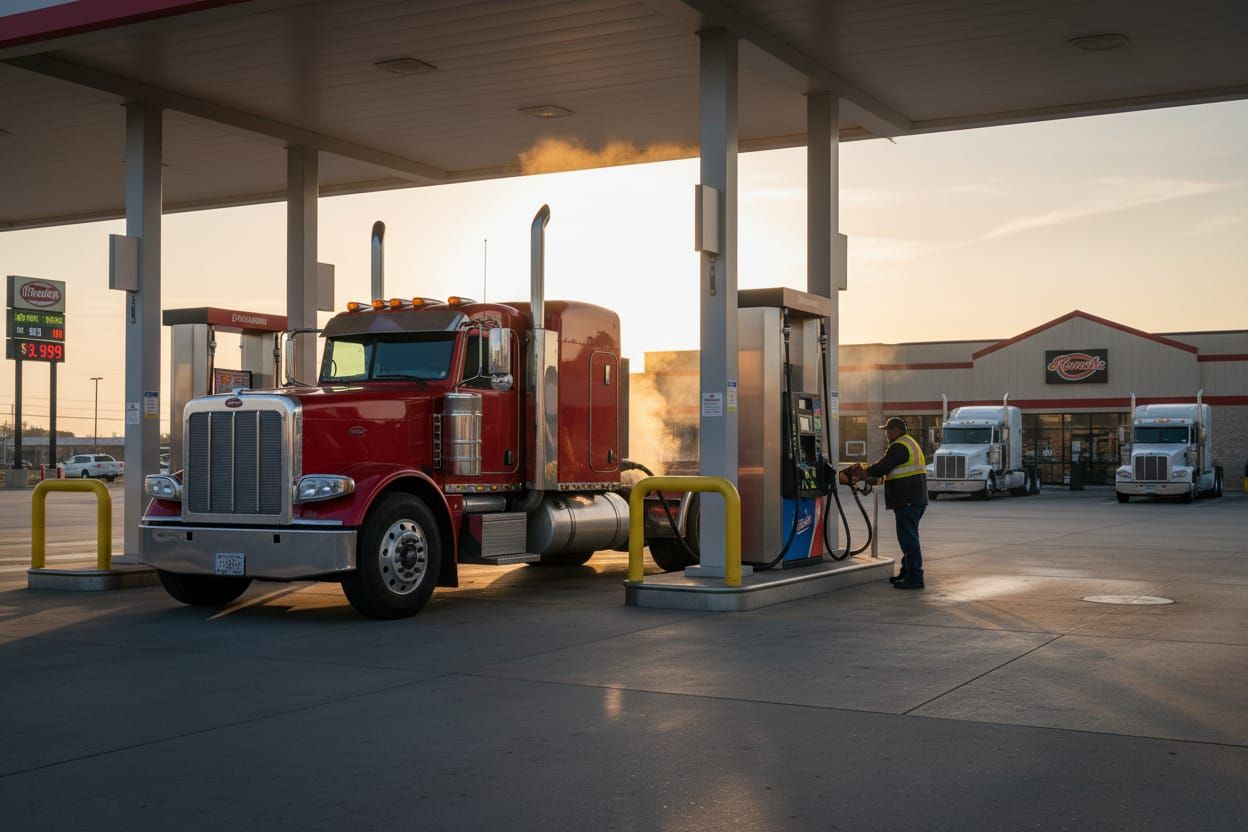
The Fuel Math: Why 1 MPG Matters More Than You Think
| MPG | Gallons/Year (120K mi) | Annual Cost ($4/gal) | Savings vs 6.0 MPG |
|---|---|---|---|
| 5.5 MPG | 21,818 | $87,272 | -$7,272 more |
| 6.0 MPG | 20,000 | $80,000 | Baseline |
| 6.5 MPG | 18,462 | $73,846 | $6,154 saved |
| 7.0 MPG | 17,143 | $68,571 | $11,429 saved |
| 7.5 MPG | 16,000 | $64,000 | $16,000 saved |
| 8.0 MPG | 15,000 | $60,000 | $20,000 saved |
Most trucks run between 5.5 and 7.5 MPG. The difference between the worst and best is $23,000/year — the cost of a used car, a vacation, or several months of truck payments.
Speed: The #1 Factor You Control
Every mile per hour above 55 costs fuel. This isn’t opinion — it’s aerodynamic physics. Air resistance increases with the square of speed.
55 mph
Best MPG (baseline)
60 mph
-5% fuel economy
65 mph
-12% fuel economy
70 mph
-22% fuel economy
75 mph
-33% fuel economy
The math: Dropping from 65 to 60 mph on a 600-mile run adds ~50 minutes to your trip but saves roughly 10 gallons ($40). Over a year of 120,000 miles, that’s $4,000-$6,000 saved — just from 5 mph less.
6 Driving Habits That Save Fuel
1
Progressive Shifting
Shift at 1,200-1,500 RPM instead of winding out to 1,800+. Low RPM = less fuel burned per shift. Your torque peak is where your engine works most efficiently.
Savings: 5-8%
2
Smooth Acceleration
Jackrabbit starts from red lights and ramps waste fuel. Accelerate gradually — take 15-20 seconds to reach cruising speed. Momentum is free; acceleration costs diesel.
Savings: 3-5%
3
Anticipate Stops
See a red light 1/4 mile ahead? Coast. Don’t accelerate into a stop just to slam the brakes. Every time you brake, you’re converting fuel-purchased speed into brake heat — wasted money.
Savings: 2-4%
4
Use Cruise Control
Consistent speed beats variable speed. Your foot on the pedal creates 2-5 mph swings you don’t notice but your fuel gauge does. Cruise control on flat terrain saves 3-6%.
Savings: 3-6%
5
Minimize Idling
A semi idles at 0.8-1.5 gallons per hour. 8 hours of idling = 6-12 gallons wasted. Use APUs ($3,000-$8,000 installed) or idle-reduction systems. The payback period is 6-18 months.
Savings: $3,000-$7,000/year
6
Reduce Following Distance to Draft? Don’t.
“Drafting” behind another truck at 50-100 feet saves maybe 5% fuel but dramatically increases accident risk. One rear-end collision costs $50,000-$500,000+. The fuel savings aren’t worth the risk — or the insurance premium increase.
Savings: Not worth the risk
Maintenance That Pays for Itself in Fuel
| Maintenance Item | When | Cost | Fuel Impact | Annual Savings |
|---|---|---|---|---|
| Tire pressure check | Daily (pre-trip) | $0 (your time) | Each 10 PSI low = -1% MPG | $500–$2,000 |
| Air filter replacement | Every 25,000-50,000 miles | $30–$80 | Clogged filter = -3-5% MPG | $2,000–$4,000 |
| Fuel filter replacement | Every 15,000-30,000 miles | $20–$50 | Restricted = -1-3% MPG | $800–$2,400 |
| Wheel alignment | Every 50,000 miles or after pothole | $150–$300 | Misalignment = -2-3% MPG | $1,600–$2,400 |
| Proper oil viscosity | Every oil change | $0 (just choose correctly) | Wrong viscosity = -1-2% MPG | $800–$1,600 |
| Injector cleaning | Every 100,000-150,000 miles | $200–$500 | Dirty injectors = -3-5% MPG | $2,000–$4,000 |
Total maintenance investment: ~$500-$1,000/year. Potential fuel savings: $7,000-$16,000/year. That’s a 7x-16x return on investment.
Aerodynamic Upgrades: What Actually Works
At highway speed, 50-65% of your fuel fights air resistance. Reducing drag has a direct, measurable impact on MPG.
High Impact
Trailer Tail / Boat Tail
Collapsible panels on the rear of the trailer reduce the vacuum behind it.
Cost: $2,000–$4,000 MPG gain: 4-6% Payback: 6-12 months
High Impact
Trailer Skirts
Side panels between trailer wheels reduce underbody turbulence.
Cost: $1,500–$3,000 MPG gain: 3-5% Payback: 6-12 months
Medium Impact
Gap Reducers
Fill the gap between cab and trailer to smooth airflow.
Cost: $500–$1,500 MPG gain: 1-3% Payback: 3-8 months
Medium Impact
Roof Fairing Adjustment
Ensure your roof fairing height matches your trailer height. A mismatched fairing creates turbulence.
Cost: $0–$200 (adjustment) MPG gain: 1-3% Payback: Immediate
Low Impact (But Free)
Remove Unnecessary Accessories
Extra lights, bug shields, visors, and chrome all create drag. If it’s not functional, it’s costing you fuel.
Cost: $0 MPG gain: 0.5-1% Payback: Immediate
Combined aero upgrades can improve MPG by 8-15%. On $74,000/year in fuel, that’s $6,000-$11,000 saved annually. Most upgrades pay for themselves within a year.
Buying Fuel Smarter
You can’t control the price of diesel. But you can control where, when, and how you buy it.
Use Fuel Cards
Fleet fuel cards (WEX, Comdata, EFS, TCS) offer $0.03-$0.15/gallon discounts at network stops. At 18,000 gallons/year, that’s $540-$2,700 saved. Plus detailed IFTA reporting.
Fuel Price Apps
GasBuddy, Trucker Path, and DAT show real-time diesel prices. A 5-minute search before fueling can save $0.10-$0.30/gallon. On a 150-gallon fill, that’s $15-$45.
Avoid Highway-Adjacent Stations
Truck stops right at the interstate exit charge a premium. Stations 1-2 miles off the highway are often $0.10-$0.30/gallon cheaper. The 5 extra minutes is worth it.
Fuel in Cheaper States
State diesel taxes vary by $0.15-$0.60/gallon. Plan fill-ups in low-tax states when your route allows. Top off before entering California, Pennsylvania, or Illinois.
Don’t Top Off at Full Price
If you’re at 3/4 tank and the price is high, buy just enough to get to the next stop. If the price is low, fill up completely. Treat fuel like a commodity — buy more when it’s cheap.
Loyalty Programs
Pilot/Flying J, Love’s, and TA/Petro loyalty programs offer points worth $0.01-$0.05/gallon in rebates, plus free showers, parking, and other perks. Stack with fuel card discounts.
Idle Reduction: Stop Burning Fuel While Parked
The average long-haul trucker idles 6-8 hours per day when stopped. At 1 gallon/hour, that’s $24-$32/day in wasted fuel — $6,000-$8,000/year.
| Solution | Cost | Fuel Saved/Year | Payback |
|---|---|---|---|
| APU (diesel) | $5,000–$10,000 installed | $5,000–$7,000 | 12-18 months |
| APU (battery/electric) | $3,000–$7,000 installed | $6,000–$8,000 | 6-12 months |
| Shore power (truck stop) | $1-$3/hour | $3,000–$5,000 | Immediate |
| Automatic engine start/stop | $500–$1,500 (many trucks have it) | $2,000–$4,000 | 3-6 months |
Anti-idle laws: Many states and cities prohibit idling beyond 3-5 minutes. California, New York, New Jersey, Massachusetts, and many others enforce these. Fines range from $100-$25,000. An APU isn’t just about fuel savings — it’s about legal compliance.
How Fuel Efficiency Connects to Insurance
You might not think fuel efficiency and insurance are related. They are — in ways most truckers don’t realize.
APUs Reduce Fire Risk
Idling engines in sleeper berths have caused truck fires. APUs eliminate this risk. Some insurers ask about idle-reduction equipment during underwriting.
Slower Speed = Fewer Accidents
Driving 60 instead of 70 reduces stopping distance by ~50 feet and reduces accident severity. Lower speed = fewer claims = lower premiums over time.
Better Tires = Fewer Blowouts
Proper tire maintenance for fuel efficiency also prevents blowouts. Fewer blowout claims means a cleaner loss history.
Fuel Savings Fund Better Coverage
Saving $10,000/year on fuel gives you budget to buy better coverage — lower deductibles, higher limits, comp/collision you might otherwise skip.
Fuel Efficiency Myths — Debunked
Myth
”Premium diesel gives better MPG”
Premium diesel costs $0.10-$0.30 more per gallon. The MPG improvement is typically 0-1%. You’re paying more than you’re saving. Standard #2 diesel is fine for almost all trucks.
Myth
”Fuel additives improve MPG by 10-20%”
Most independent tests show fuel additives improve MPG by 0-2% at best. The ones promising 10-20% improvements are selling snake oil. Your money is better spent on proper maintenance.
True
”Cold weather reduces fuel economy”
Yes — by 5-15%. Diesel thickens in cold, engines take longer to warm up, tires lose pressure, and you idle more for heat. Winter MPG drops are real and unavoidable (but APUs help).
Myth
”Newer trucks always get better MPG”
Newer emissions systems (DPF, DEF, EGR) actually reduce fuel economy by 3-8% compared to pre-emissions trucks. Newer trucks have better aerodynamics but heavier emissions equipment. The net is roughly equal.
True
”Weight affects fuel economy”
Every 1,000 lbs of extra weight costs roughly 0.5% fuel economy. Running heavy (79,000+ lbs) vs light (45,000 lbs) can mean a 1.5-2 MPG difference. You can’t always control your load weight, but you can avoid carrying unnecessary items in your cab and trailer.
Frequently Asked Questions
What’s a good MPG for a semi truck?
Average is 5.5-6.5 MPG. Good is 6.5-7.5 MPG. Excellent is 7.5+ MPG. Your actual MPG depends on speed, terrain, weight, aerodynamics, and driving habits. Flat terrain at 60 mph with a light load can hit 8+ MPG. Mountains at 70 mph with 80,000 lbs might drop to 4.5 MPG.
How much do fuel cards actually save?
$0.03-$0.15/gallon depending on the card, network, and volume. At 18,000 gallons/year, that’s $540-$2,700. Some cards also offer maintenance discounts and free IFTA reporting. The savings are real and consistent.
Is an APU worth it for regional drivers?
If you idle more than 4 hours/day, yes. Regional drivers who go home most nights may only idle 1-2 hours — the payback takes longer. For long-haul drivers who sleep in the truck, an APU pays for itself in under a year.
Do speed limiters actually save fuel?
Yes. Trucks governed at 62-65 mph consistently get 0.5-1.5 MPG better than ungoverned trucks. It’s frustrating, but the math is clear: at 120,000 miles/year, governing at 63 mph instead of 70 mph saves $6,000-$10,000 in fuel annually.
Related Tools
Free Tool Fuel Surcharge Calculator Calculate the right fuel surcharge for your loads based on current diesel prices and MPG. Free Tool Cost Per Mile Calculator See how fuel efficiency improvements change your overall cost per mile. Free Tool Fuel Tax (IFTA) Estimator Estimate your quarterly IFTA fuel tax liability based on miles driven per state.
Put Your Fuel Savings to Work
Save $10,000 on fuel this year? Use some of it to upgrade your insurance coverage. Lower deductibles, higher limits, and comp/collision you might have been skipping. We’ll help you find the right balance.
Mon–Fri 8am–5pm Mountain