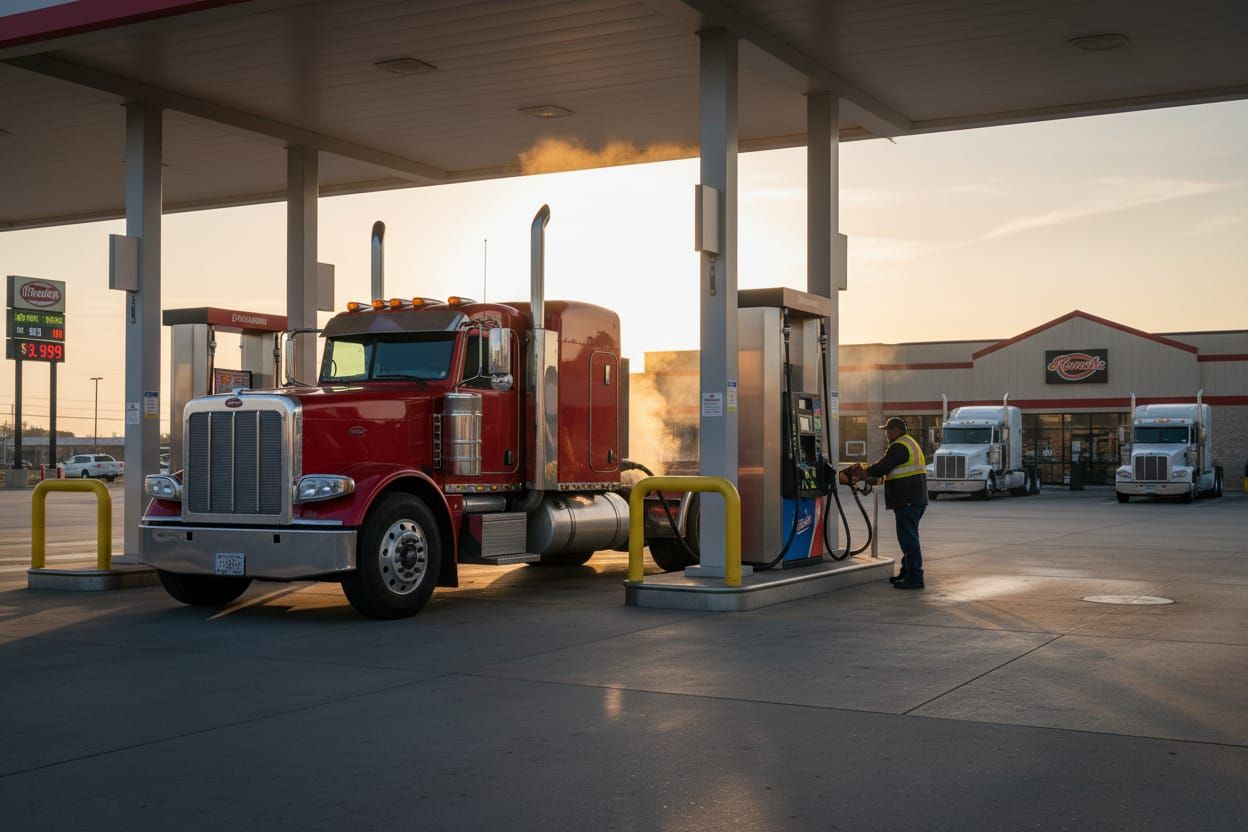
What Is a Fuel Surcharge?
A fuel surcharge is a variable fee added to freight rates that adjusts automatically as diesel prices change. It protects both carriers and shippers:
For Carriers (You)
Protects your margin when diesel spikes. Without FSC, a $0.50/gallon increase could wipe out your profit on every load.
For Shippers
Keeps base rates stable. Shippers prefer predictable base rates with a variable fuel component they can budget for.
For Brokers
Brokers collect FSC from shippers and pass some (or all) to carriers. The gap between what they collect and what they pass through is where problems arise.
30-40%
Of operating costs are fuel
6.5 MPG
Average fuel economy (class 8)
$3.50-$4.50
Typical diesel price range
$0.54/mile
Fuel cost at $3.50/gal, 6.5 MPG
How Fuel Surcharge Is Calculated
Most FSC programs use the same basic formula. The key variables are the base fuel price, the current fuel price, and your fuel economy.
The Standard Formula
FSC per mile = (Current Diesel Price - Base Diesel Price) ÷ MPG
Example Calculation
Current diesel price (DOE average) $3.85/gallon
Base diesel price (contract baseline) $1.20/gallon
Difference $2.65/gallon
Fuel economy (MPG) 6.5 MPG
FSC per mile $2.65 ÷ 6.5 = $0.408/mile
On a 500-mile load, that’s $204 in fuel surcharge on top of the base rate.
The DOE Reference Price
Most FSC programs use the U.S. Department of Energy’s weekly diesel price report as their reference. Published every Monday at eia.gov, this is the industry-standard benchmark. Key facts:
- Published weekly (Monday) based on previous week’s data
- National average + regional breakdowns available
- Used by 80%+ of FSC programs in the industry
- Typically updates in FSC tables the following week
Reading an FSC Table
Many carriers and brokers use a table format instead of a formula. Here’s a typical FSC scale:
| DOE Diesel Price Range | FSC Per Mile | FSC % of Linehaul |
|---|---|---|
| $3.00 - $3.09 | $0.28 | 14% |
| $3.10 - $3.19 | $0.29 | 15% |
| $3.20 - $3.29 | $0.31 | 16% |
| $3.30 - $3.39 | $0.32 | 17% |
| $3.40 - $3.49 | $0.34 | 18% |
| $3.50 - $3.59 | $0.35 | 19% |
| $3.80 - $3.89 | $0.40 | 22% |
| $4.00 - $4.09 | $0.43 | 24% |
| $4.50 - $4.59 | $0.51 | 29% |
| $5.00+ | $0.58+ | 33%+ |
Watch the Base Price: The lower the base price in the FSC formula, the higher your surcharge. A base of $1.20/gal gives you a much better FSC than a base of $2.50/gal. During negotiations, the base price is the most important number to fight for.
How to Negotiate a Fair Fuel Surcharge
1
Know your actual fuel cost per mile
Calculate: (price per gallon) ÷ (your MPG) = cost per mile. If diesel is $3.85 and you get 6.5 MPG, your fuel cost is $0.59/mile. The FSC should cover most of this above the base price.
2
Fight for a low base price
Base price determines how much FSC you receive. Push for $1.10-$1.25/gal as the base. Some brokers try to set the base at $2.50+ which dramatically cuts your surcharge.
3
Insist on DOE reference pricing
Some brokers use arbitrary fuel benchmarks or “company fuel averages.” DOE weekly average is the transparent industry standard. If they won’t use DOE, that’s a red flag.
4
Verify FSC is passed through — not absorbed
Ask brokers: “What FSC do you collect from the shipper, and what do you pass to me?” Some brokers pocket 30-50% of the FSC they collect. This is legal but not ethical.
5
Negotiate MPG factor separately
Some FSC tables assume 6.0 MPG. If your truck gets 7+ MPG, you’re subsidized. If you get 5.5 MPG (older truck), you’re losing money. Negotiate MPG based on your actual equipment.
6
Get it in writing in the contract
FSC terms should be explicitly stated: base price, reference source, MPG factor, update frequency, and how it appears on settlements. Verbal FSC agreements are meaningless.
5 Fuel Surcharge Tricks to Watch For
1
The High Base Price
Setting the base at $2.50+ instead of $1.20. At $3.85 diesel, a $1.20 base gives you $0.408/mile FSC. A $2.50 base gives you $0.208/mile — half the money for the same fuel cost.
2
The “Included in Rate” Trick
“Our rate already includes fuel.” This means when fuel spikes $0.50/gallon, you eat the entire increase. Always separate base rate from FSC — it protects you when prices rise.
3
Delayed Updates
Using “last month’s” fuel average instead of the current week. In a rising fuel market, a 2-4 week delay costs you real money. Updates should be weekly based on DOE Monday releases.
4
Capped FSC
“FSC will not exceed $0.35/mile.” When diesel hits $5.00, your fuel cost per mile is $0.77 — but your FSC is capped at $0.35. You absorb $0.42/mile. Never accept capped FSC without a corresponding floor on the base rate.
5
Percentage of Linehaul
Calculating FSC as a percentage of the base rate (e.g., 22%) instead of per-mile. On short, high-rate loads this might be fine. On long, low-rate loads, percentage-based FSC often underpays your actual fuel cost.
Are You Actually Covering Your Fuel Costs?
Use this quick check to see if your FSC covers your actual fuel expense above the base rate:
Step 1: Your actual fuel cost per mile
(Current diesel price) ÷ (Your MPG)
$3.85 ÷ 6.5 = $0.592/mile
Step 2: Your base fuel cost per mile
(Base price in contract) ÷ (MPG factor in contract)
$1.20 ÷ 6.0 = $0.200/mile
Step 3: What FSC should be
Step 1 - Step 2
$0.592 - $0.200 = $0.392/mile
Step 4: Compare to what you receive
If your FSC < Step 3, you’re losing money on fuel
Receiving $0.35/mile? You’re short $0.042/mile = $21/load on 500 miles
How Fuel Costs Affect Your Insurance
Fuel costs don’t directly affect your insurance premium, but they affect your business in ways that do:
Revenue Per Mile Drops
When fuel eats more of your rate, your effective revenue drops. Carriers operating on thin margins take more loads, drive more miles, and increase exposure — all of which raises risk.
Maintenance Gets Deferred
When cash is tight from fuel costs, maintenance gets pushed back. Deferred maintenance leads to breakdowns and accidents — which directly increase your insurance costs.
Cargo Value Exposure
Your cargo insurance should cover the value of what you haul. Fuel surcharges don’t change cargo values, but hauling more loads to cover fuel costs increases your total exposure.
Insurance Premiums Are Deductible
Every dollar you pay in insurance premiums reduces your taxable income. At 30% combined tax rate, a $15,000 annual premium effectively costs $10,500 after tax deductions.
Frequently Asked Questions
Should I accept loads with no fuel surcharge?
Generally no — unless the all-in rate is high enough to cover your fuel plus profit. “No FSC” loads mean you absorb 100% of fuel price volatility. Some shippers build fuel into a higher base rate (which can work in your favor when fuel drops), but this is risky when prices are rising. Always calculate your per-mile cost before accepting any load.
What’s the best fuel surcharge base price to negotiate?
Industry standard is around $1.10-$1.25/gallon. This was approximately the DOE average when FSC programs became widespread. Some legacy contracts still use $1.10. Anything above $1.50 as a base price is unfavorable to the carrier. Never accept a base above $2.00 — at that point the FSC barely covers your actual fuel increase.
Can I negotiate FSC on spot market loads?
Spot market rates typically include fuel in the all-in price. When you see a load posted at $2.50/mile on a load board, that usually includes everything. If a broker quotes a base rate plus FSC separately on a spot load, verify the math — some split the total to make the base rate look higher or the FSC look more generous than it is.
Is fuel surcharge taxable income?
Yes — FSC is revenue and is included in your gross income. However, the fuel you purchase is a deductible business expense. The net effect is roughly neutral: you receive FSC as income and deduct the fuel as an expense. Track both carefully for your taxes. See our Tax Deductions Guide for details on fuel deductions.
Related Tools
Free Tool Fuel Surcharge Calculator Calculate the right fuel surcharge for any load based on current diesel prices and your MPG. Free Tool Cost Per Mile Calculator Factor fuel costs into your total cost per mile to set profitable rates.
Protect Your Margins — Including Insurance
Fuel isn’t the only cost eating your profit. Make sure your insurance is competitive too. We shop multiple carriers to find you the best rate.
Or call (208) 602-1344