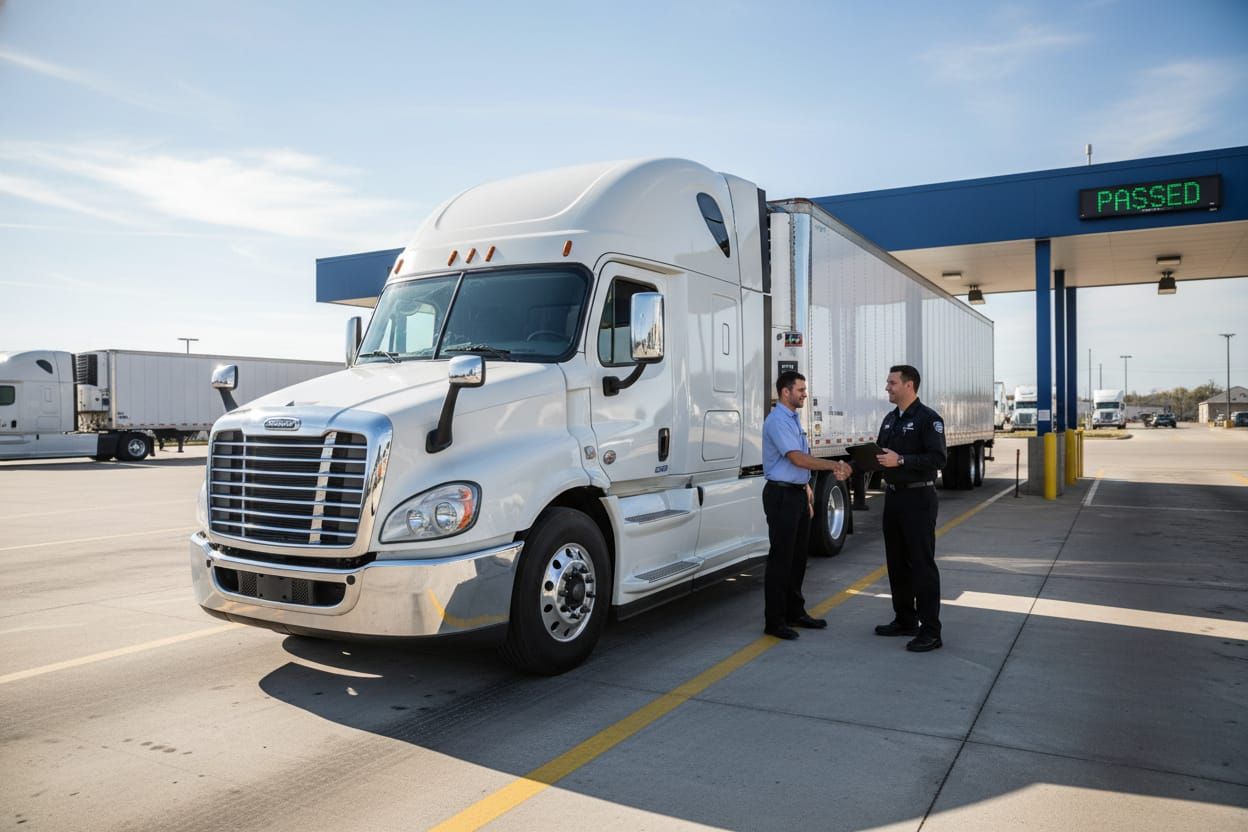
Why Hazmat Pays More (And Costs More)
Hazmat loads typically pay 10-30% more per mile than general freight. The premium exists because hauling hazardous materials requires more credentials, higher insurance, stricter compliance, and greater risk. Not every driver can do it, which limits supply.
The Upside
- 10-30% higher per-mile rates
- Less competition (fewer endorsed drivers)
- More consistent freight (chemicals, fuel always move)
- Long-term shipper relationships
- Specialized = harder to replace
The Cost
- CDL-H endorsement + TSA background check
- Higher insurance premiums (20-50%+ more)
- Pollution liability coverage required
- Additional compliance requirements
- Higher FMCSA liability minimums ($1M-$5M)
Getting Your Hazmat Endorsement (CDL-H)
The hazmat endorsement is added to your existing Commercial Driver’s License. You can’t just apply — there’s a multi-step process involving both your state DMV and the federal government.
1
Apply at Your State DMV
Start the CDL-H application at your state’s DMV or licensing office. You’ll need your current CDL.
Cost: $10-$100 (varies by state)
2
TSA Background Check
Submit fingerprints and personal information for a federal security threat assessment through the TSA. This is required by the USA PATRIOT Act.
Cost: ~$86.50 | Timeline: 30-60 days
3
Study the HazMat Table
Learn the 9 hazard classes, placarding requirements, shipping papers, emergency response procedures, and loading/unloading rules from 49 CFR Parts 171-180.
Focus: Hazard classes, placarding, shipping papers, emergency procedures
4
Pass the Written Test
Take and pass the hazmat knowledge test at the DMV. Most states require 80% or higher. You can retake if needed.
30 questions | 80% passing score typical
5
Receive Your CDL-H
Once the TSA clears you and you pass the test, your state adds the H endorsement to your CDL.
Renewal: Every 5 years (TSA check again at renewal)
TSA Disqualifiers
You will be permanently denied for certain felony convictions (espionage, treason, terrorism, murder, use of weapons of mass destruction). You may be temporarily denied for other felonies committed within the last 7 years, including drug trafficking, assault with intent to kill, arson, robbery, and immigration violations. A full list is in 49 CFR 1572.103.
The 9 Hazard Classes
Every hazardous material falls into one of 9 classes. Each class has specific placarding, loading, and insurance implications. Knowing your class determines what you can haul and what insurance you need.
1
Explosives
Dynamite, ammunition, fireworks, blasting caps
$5M+ liability
2
Gases
Propane, oxygen, acetylene, refrigerant
$1M-$5M liability
3
Flammable Liquids
Gasoline, diesel, acetone, paint, alcohol
$1M-$5M liability
4
Flammable Solids
Matches, magnesium, sulfur, sodium
$1M-$5M liability
5
Oxidizers & Organic Peroxides
Ammonium nitrate, hydrogen peroxide, bleach
$1M-$5M liability
6
Toxic & Infectious
Pesticides, medical waste, dyes, tear gas
$1M-$5M liability
7
Radioactive
Medical isotopes, uranium, smoke detectors
$5M+ liability
8
Corrosives
Battery acid, sulfuric acid, sodium hydroxide
$1M-$5M liability
9
Miscellaneous
Lithium batteries, dry ice, magnetized materials, asbestos
$1M liability
FMCSA Insurance Requirements for Hazmat
The federal government requires significantly higher liability limits for hazmat carriers than general freight. Your minimum depends on what you haul.
| Cargo Type | Minimum Liability | Typical Market |
|---|---|---|
| General freight (non-hazmat) | $750,000 | $1,000,000 |
| Oil (petroleum products) | $1,000,000 | $2,000,000-$5,000,000 |
| Hazmat (general) | $1,000,000 | $2,000,000-$5,000,000 |
| Poison/toxic inhalation | $5,000,000 | $5,000,000+ |
| Explosives/radioactive | $5,000,000 | $5,000,000-$10,000,000 |
These Are Just the Federal Minimums
Many shippers and brokers require limits well above the FMCSA minimum. Fuel haulers commonly need $2M-$5M. Chemical companies often require $5M+. Your actual required limits depend on who you haul for, not just what the government mandates.
How Hazmat Affects Your Insurance Costs
Adding hazmat to your operation doesn’t just add a line item — it changes the entire cost structure of your insurance program. Here’s what to expect.
General Freight Carrier
Non-hazmat, 1 truck, new authority
Auto Liability ($1M) $9,000-$14,000
Cargo ($100K) $800-$1,500
Physical Damage $2,000-$4,000
General Liability $500-$1,200
Pollution Liability Not needed
Total Annual $12,300-$20,700
VS
Hazmat Carrier
Fuel/chemicals, 1 truck, new authority
Auto Liability ($1M-$5M) $14,000-$25,000
Cargo ($100K) $1,200-$2,500
Physical Damage $2,500-$5,000
General Liability $800-$2,000
Pollution Liability $1,500-$5,000
Total Annual $20,000-$39,500
What Drives Hazmat Insurance Rates
Hazard class — higher class = higher rate
Volume hauled — tank truck vs drums vs small quantities
Routes — populated areas, tunnels, restricted zones
Experience — years hauling hazmat specifically
Driver training — beyond CDL-H certification
Safety record — HazMat BASIC score in CSA
Equipment — MC-306 vs MC-307 vs dry van
Spill history — any environmental incidents
Pollution Liability: The Coverage Most Hazmat Haulers Overlook
Standard auto liability and cargo insurance specifically exclude pollution events. If your tanker leaks diesel into a creek or chemicals spill on a highway, your regular policies won’t pay for the environmental cleanup. That’s what pollution liability covers.
What Pollution Liability Covers
- Environmental cleanup costs
- Soil and groundwater remediation
- Third-party bodily injury from contamination
- Third-party property damage from spills
- Government-ordered cleanup compliance
- Legal defense for environmental claims
- Emergency response costs
- Transportation pollution incidents (loading/unloading)
What It Doesn’t Cover
- Intentional discharge or dumping
- Fines and penalties from EPA/state agencies
- Pre-existing contamination at your yard
- Damage to your own property
- Nuclear, biological, or chemical weapons
- Known pollution conditions you failed to disclose
The Real Cost of a Hazmat Spill
Small fuel spill (under 100 gal) $10,000-$50,000
Highway chemical spill $50,000-$500,000
Waterway contamination $500,000-$5,000,000+
Residential area evacuation $1,000,000-$10,000,000+
These are cleanup costs only — not including lawsuits, fines, or lost business. Without pollution liability, you’re personally responsible for every dollar.
Placarding Rules You Need to Know
Incorrect or missing placards result in out-of-service orders, CSA violations, and potentially criminal charges. The rules are in 49 CFR 172.
When Placards Are Required
- Any quantity of Table 1 materials (explosives, poison gas, radioactive III)
- 1,001+ lbs of Table 2 materials (most other hazmat classes)
- Any amount of hazmat requiring an inhalation hazard placard
Placard Placement
- All 4 sides of the vehicle (front, back, both sides)
- At least 10.8 inches on each side (273mm diamond)
- Visible, clean, and not obscured
- Must match the shipping papers
Common Violations
- Wrong placard for the commodity
- Missing placard on one side of the vehicle
- Placard still displayed after hazmat unloaded
- Faded or damaged placards (illegible)
Placard Violation Consequences
Wrong/missing placards $250-$75,000 fine + OOS
HazMat BASIC CSA points 6-10 severity points
Shipping paper errors $250-$75,000 fine + OOS
Criminal prosecution Up to $500K + 5 years prison (willful violations)
HazMat BASIC: Your Hazmat Safety Score
The HazMat BASIC is one of the 7 CSA BASICs, and it’s the one that matters most for hazmat insurance pricing. Unlike other BASICs that measure general driving, this one specifically tracks how well you handle hazardous materials.
HazMat BASIC
Threshold: 80th percentile
What Triggers Points
- Placarding violations (wrong, missing, damaged)
- Shipping paper errors (missing, incorrect, illegible)
- Package integrity failures (leaking containers, damaged labels)
- Loading/unloading violations (incompatible materials, blocking)
- Marking/labeling errors (missing UN numbers, wrong labels)
- Vehicle equipment violations (specific to hazmat transport)
What Happens at 80th Percentile
- Warning letter from FMCSA
- Targeted inspections (more frequent roadside stops)
- Compliance review (audit)
- Insurance non-renewal or significant rate increase
- Brokers and shippers may stop using you
Insurance Impact
Underwriters check your HazMat BASIC before quoting. A score above the 65th percentile makes many carriers hesitant. Above the 80th percentile, you may not find coverage at all — and if you do, expect to pay 50-100% above standard rates.
Shipping Papers & Emergency Response
Every hazmat load requires proper shipping papers within arm’s reach of the driver. If you’re stopped or in an accident, first responders need to immediately identify what you’re carrying.
Required Information on Every Shipment
1 Proper shipping name (from the Hazardous Materials Table)
2 Hazard class or division number
3 UN/NA identification number
4 Packing group (I, II, or III)
5 Total quantity and unit of measure
6 Emergency response phone number (24/7)
7 Shipper’s certification with signature
Emergency Response Guidebook (ERG)
Every hazmat driver must carry the current ERG (published by DOT every 4 years — current edition is 2024). It tells first responders how to handle spills, fires, and exposures for every hazardous material. Keep it in the cab, accessible within arm’s reach.
Additional Hazmat Compliance Requirements
Beyond the CDL-H endorsement and insurance, hazmat operations have requirements that general freight carriers don’t deal with.
Security Plan
Required for any carrier transporting certain hazmat quantities. Must address personnel security, unauthorized access prevention, and en-route security.
49 CFR 172.802
Hazmat Training
All hazmat employees must receive initial training, then recurrent training every 3 years. Training must be documented and records retained for 3 years.
49 CFR 172.704
Route Restrictions
Certain hazmat loads (radioactive, explosives, poison inhalation) must follow preferred routes — typically interstates. Some cities and tunnels prohibit hazmat entirely.
49 CFR 397.67
Parking Restrictions
Placarded vehicles cannot be parked within 300 feet of a bridge, tunnel, dwelling, or place of assembly — except for brief (under 1 hour) operational needs.
49 CFR 397.7
Attended Vehicles
Placarded hazmat vehicles must be attended at all times or parked in a safe haven. “Attended” means the driver is in the vehicle or within 100 feet with clear line of sight.
49 CFR 397.5
Fueling Rules
Engine must be off during fueling. No smoking within 25 feet. Someone must be at the nozzle at all times. These seem obvious until you get cited for them.
49 CFR 397.13
8 Hazmat Mistakes That Get Carriers Shut Down
1
Hauling without pollution liability
One spill without coverage can cost six figures. Standard auto and cargo policies exclude pollution. This is the most expensive insurance gap in trucking.
2
Carrying only the FMCSA minimum liability
$1M in liability is the federal minimum for most hazmat, but a single serious accident can generate $5M-$20M+ in claims. Shippers increasingly require $5M+ before they’ll load you.
3
Skipping the security plan
If you haul any quantity of certain hazmat (Appendix A to 49 CFR 172.101), you need a written security plan. No plan = violation during audit.
4
Expired or missing training records
Hazmat training recertification is every 3 years, not every 5 (like TSA). Many carriers confuse the two timelines and end up with expired training documentation.
5
Wrong compatibility grouping
Loading incompatible materials on the same truck (like oxidizers near flammable liquids) is a serious violation — and a real safety hazard. Know the segregation table.
6
Not updating the MCS-150 for hazmat
Your MCS-150 (motor carrier identification report) must accurately reflect that you haul hazmat. An incorrect MCS-150 can delay insurance quotes and trigger audits.
7
Ignoring route restrictions
Some tunnels, bridges, and urban areas restrict hazmat. Using GPS apps designed for trucks (not Google Maps) helps, but ultimately the driver is responsible for knowing the rules for their specific cargo.
8
No emergency equipment
Beyond the standard truck equipment, hazmat loads may require specific spill kits, fire extinguishers (rated for the cargo class), and PPE. Check your shipper’s requirements and 49 CFR 172.
Is Hazmat Worth It for You?
The math works for some carriers and not others. Here’s a realistic look.
Hazmat Makes Sense If:
- You have 2+ years of clean driving experience
- You’re willing to invest in proper training and compliance
- You have access to consistent hazmat freight (fuel distributor, chemical shipper)
- You can pass the TSA background check
- Your revenue increase outpaces the insurance increase
- You’re building a specialized reputation
Think Twice If:
- You’re a brand-new authority (under 1 year) — most hazmat insurers won’t write you
- You have any HazMat BASIC violations already
- You plan to haul hazmat only occasionally (insurance doesn’t prorate)
- Your driving record has accidents or moving violations
- You’re not comfortable with the additional compliance burden
- You can’t find affordable pollution liability coverage
The Quick Math
If hazmat insurance costs you an extra $8,000-$20,000/year over general freight, you need the hazmat rate premium to generate at least that much additional revenue — after accounting for the extra compliance costs, training, equipment, and time spent on paperwork.
At 100,000 miles per year, an extra $0.10/mile in rate premium generates $10,000 — which may or may not break even depending on your additional insurance and compliance costs.
Hazmat Compliance Quick Checklist
Driver Requirements
- Valid CDL with H endorsement
- TSA security threat assessment (current — renewed every 5 years)
- Hazmat training completed and documented (renewed every 3 years)
- Current DOT physical on file
- Clean drug and alcohol testing record
Insurance Requirements
- Auto liability at required minimums for cargo class ($1M-$5M)
- Pollution liability coverage in force
- Cargo insurance covering hazmat commodities specifically
- Umbrella/excess liability (recommended — $2M-$10M)
- MCS-90 endorsement filed with FMCSA
Operational Requirements
- Written security plan (if required for your materials)
- Emergency Response Guidebook in cab
- Proper placards for all 4 sides of vehicle
- Shipping papers within arm’s reach
- 24/7 emergency response phone number on papers
- Spill kit appropriate for cargo
- Fire extinguisher rated for cargo class
- MCS-150 updated to reflect hazmat operations
Frequently Asked Questions
Can I haul hazmat with a new authority?
Technically yes, but finding insurance is the hard part. Most hazmat insurers want at least 1-2 years of authority history and hazmat-specific experience. Some markets will write a new authority for fuel hauling with experienced drivers, but expect to pay premium rates.
Do I need the H endorsement if I only haul small quantities?
It depends on the material and quantity. Some materials (Table 1: explosives, poison gas, radioactive III) require the endorsement for any quantity. Others (Table 2) only require it above certain thresholds. However, even if the CDL-H isn’t legally required, your insurance company may require it — and shippers almost certainly will.
What’s the difference between hazmat and HAZWOPER?
CDL-H and hazmat training (49 CFR 172) cover the transportation of hazardous materials. HAZWOPER (29 CFR 1910.120) covers cleanup and emergency response to hazmat releases. As a hauler, you need hazmat transportation training. You’d need HAZWOPER training if you also handle spill cleanup (most drivers don’t).
Does hauling fuel require different insurance than hauling chemicals?
Both are hazmat, but yes — the specifics differ. Fuel haulers (Class 3 flammable liquids) typically need $1M-$5M in liability plus pollution coverage. Chemical haulers may need higher limits depending on the specific chemicals (toxic inhalation hazards require $5M). Tank truck operations also require specific endorsements and equipment that dry van hazmat doesn’t.
Can my regular insurance agent handle hazmat coverage?
Maybe. Hazmat insurance is a specialty — not every agent has access to the markets that write it. You want an agent who regularly places hazmat policies, understands pollution liability, and knows which carriers actually write new hazmat operations vs. which ones just say they do. Ask how many hazmat policies they’ve written in the last year.
Related Guides
FMCSA Insurance Requirements Federal liability minimums, MCS-90, BMC-91, and filing requirements. Umbrella & Excess Liability When $1M isn’t enough — layered coverage for hazmat and high-risk operations. CSA Scores Explained How all 7 BASICs work, including the HazMat BASIC threshold.
Need Hazmat Insurance?
We insure hazmat carriers — fuel haulers, chemical transporters, and everything in between. We’ll help you find the right liability limits, pollution coverage, and cargo insurance for your specific materials.
Or call us: (208) 884-1118