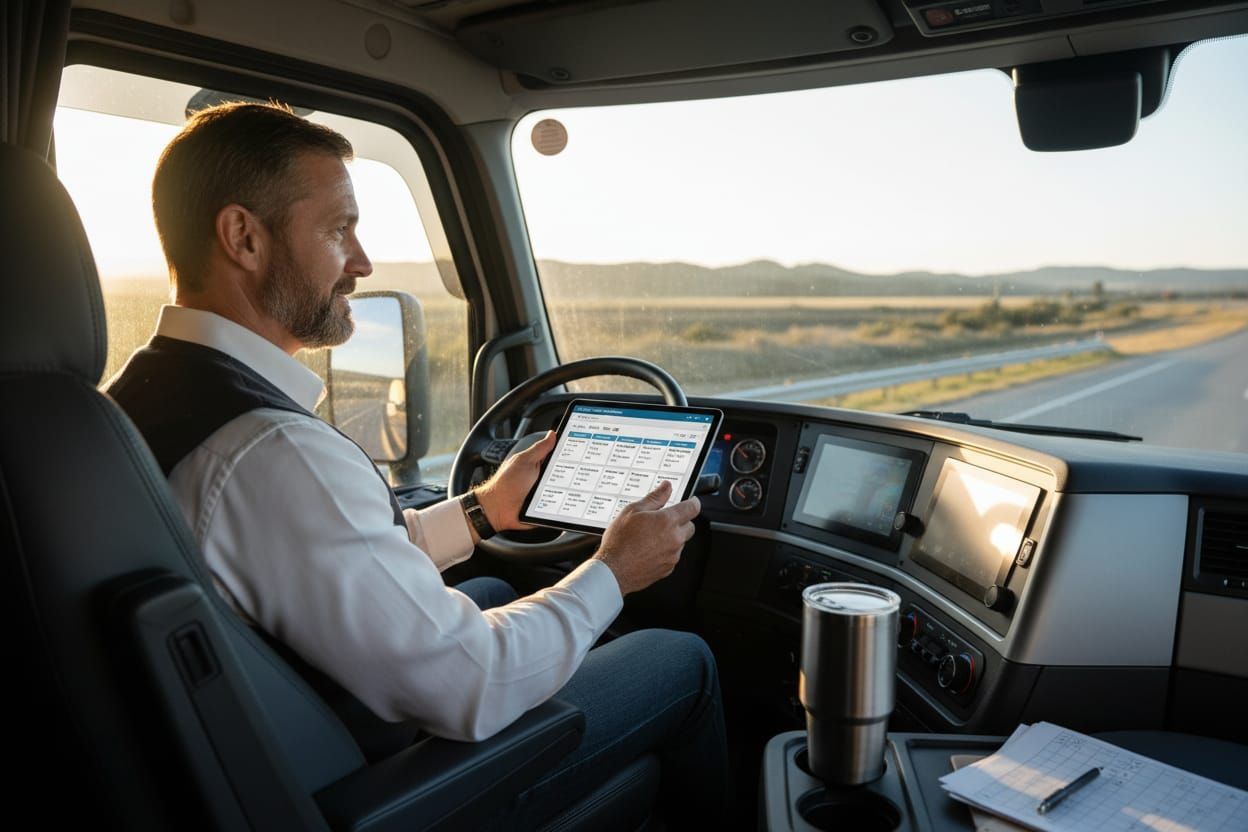
The Communication Toolkit
Modern truckers need multiple communication channels. Each serves a different purpose:
CB Radio
Real-time road intelligence
Hear about accidents, road closures, police activity, and weather conditions from drivers ahead of you. Channel 19 is the universal highway channel.
$50-$300
Hands-Free Phone
Dispatch, brokers, customers
Bluetooth headset or truck-mounted system. Required by federal law — handheld phone use is a CSA violation and a $2,750 fine.
$30-$200
Fleet Management App
Load tracking, messaging, documents
Digital dispatch, ELD integration, document scanning, messaging. Replaces paper and phone calls.
$0-$50/month
Trucker Community Apps
Peer intelligence, reviews, alerts
Trucker Path, Trucker Tools, CDL Life — parking availability, fuel prices, weigh station status, truck stop reviews.
Free-$10/month
CB Radio: Still Essential in 2026
Despite smartphones, CB radio remains the fastest way to get real-time road intelligence from drivers who are actually there.
Essential CB Channels
| Channel | Purpose | When to Use |
|---|---|---|
| Ch 19 | Highway / general trucking | Always — this is the primary trucker channel |
| Ch 9 | Emergency | Breakdowns, accidents, emergencies only |
| Ch 17 | Truck-to-truck (alternate) | When Ch 19 is congested in urban areas |
| Ch 21 | Secondary highway | Some regions use this alongside Ch 19 |
How CB Prevents Accidents
!
Accident ahead warnings
Drivers ahead report crashes, stopped traffic, and debris. You get minutes of advance notice to slow down safely.
W
Weather conditions
Real-time reports of ice, fog, snow, and wind from drivers in the area. Better than any forecast.
C
Construction zone updates
Lane closures, flag operations, and slowdowns. Know what’s ahead before your GPS updates.
P
Passing coordination
On two-lane roads, trucks communicate to coordinate safe passing. “You got it, driver” can prevent head-on collisions.
B
Backing guidance
At truck stops and tight docks, another driver on the radio can guide your blind side. Prevents backing accidents — one of the most common claims.
Hands-Free Requirements: The Law Is Clear
Federal law (49 CFR 392.82) prohibits CMV drivers from using handheld mobile phones while driving. Violations are serious:
$2,750
Fine per violation (driver)
$11,000
Fine per violation (carrier)
60 Days
CDL disqualification (2 violations)
120 Days
CDL disqualification (3+ violations)
What’s Allowed
Allowed
- Bluetooth headset (one-button answer)
- Truck-mounted hands-free system
- Single button to dial/answer
- Voice-activated commands
- CB radio (exempt from phone rules)
Prohibited
- Holding phone while driving
- Dialing (more than one button)
- Texting or reading texts
- Reaching for phone if it requires moving from seated position
- Using phone at any time while driving
Fleet Communication Systems
For owner-operators building a fleet, communication systems scale your operation:
| Need | Solo O/O Solution | Small Fleet Solution |
|---|---|---|
| Dispatch | Phone + load board app | TMS (Transportation Management System) |
| Driver messaging | Text/call | In-app messaging (Samsara, KeepTruckin) |
| Document exchange | Photo/email | Digital POD with signature capture |
| Location tracking | ELD-based | Real-time GPS via fleet platform |
| Alerts | Manual monitoring | Automated: HOS warnings, speed alerts, geofencing |
| Monthly cost | $0-$30 | $25-$60/truck |
How Communication Reduces Insurance Costs
Better communication = fewer claims = lower premiums. Here’s the direct connection:
Accident avoidance
CB warnings about road hazards give you advance notice that prevents rear-end collisions. Fewer accidents = fewer claims.
Faster incident reporting
Fleet communication tools let drivers report accidents immediately with photos and details. Quick reporting improves claim outcomes.
Backing accident prevention
Radio coordination during backing maneuvers prevents one of the most common and expensive claim types. Dash cams combined with radio guidance cover you.
Documentation for disputes
Digital communication creates an audit trail. When a shipper claims cargo damage, timestamped messages and photos prove your side.
Compliance monitoring
Fleet alerts for HOS violations, speeding, and hard braking help prevent the behaviors that cause accidents and raise premiums.
Emergency response
Quick communication during a roadside emergency gets help faster and provides the documentation your insurer needs.
Communication Best Practices
1
Set up hands-free before you roll
Pair Bluetooth, position headset, test voice commands. Never configure technology while driving.
2
Monitor Ch 19 in unfamiliar areas
Local drivers know the road. Listen for warnings about construction, bad roads, and local restrictions.
3
Communicate at every backing maneuver
Ask for a spotter when possible. Use radio to communicate with other drivers in truck stop lots.
4
Report hazards you see
Stopped vehicles, debris, wildlife, ice — report it on Ch 19. The driver behind you will appreciate it.
5
Keep dispatch updated on delays
Communicating proactively about detention and delays prevents rushed driving that causes accidents.
Frequently Asked Questions
Is a CB radio required by law?
No, CB radios are not legally required. But experienced drivers consider them essential safety equipment. The advance warning you get from other drivers about road hazards, weather, and accidents is worth far more than the cost of the radio.
Can I use a smartwatch to answer calls while driving?
Yes, if it requires only one button press and doesn’t require you to reach for it in a way that takes you out of your seated position. The key requirement is hands-free operation — the fewer buttons and less distraction, the better.
What’s the best Bluetooth headset for trucking?
Look for noise-canceling capability (truck cab noise is 80+ dB), long battery life (12+ hours), comfortable for extended wear, and simple one-button operation. Over-ear styles tend to be more comfortable for long shifts than earbuds.
Does distracted driving affect my insurance?
Absolutely. A handheld phone violation adds points to your CSA score and appears on your MVR. Insurers see this as a major risk factor — it can increase your premium by 15-30%. Multiple violations can make you uninsurable through standard markets.
Safe Drivers Pay Less for Insurance
Good communication habits lead to fewer claims and lower premiums. Let RMS find you the best rate for your clean record.
Or call (833) 472-7867 to speak with a trucking insurance specialist