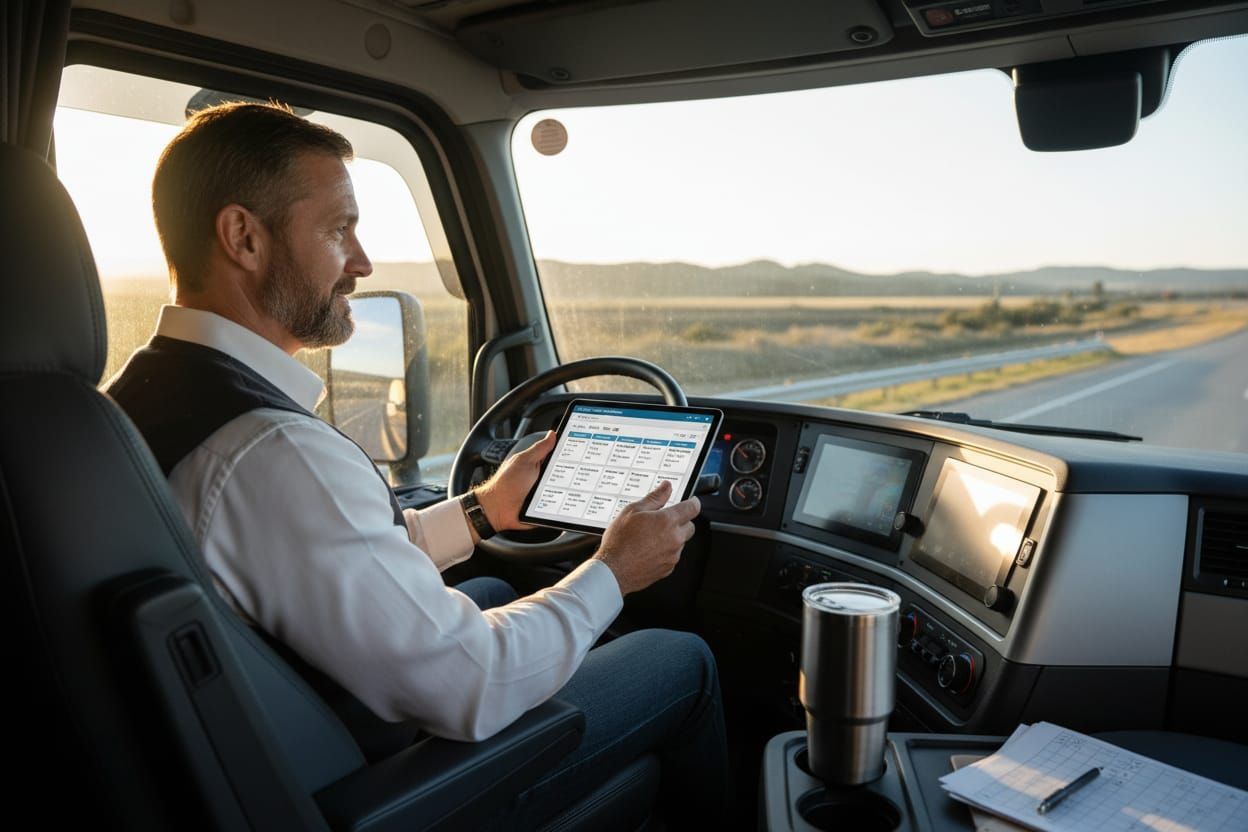
The Essential Tech Stack
Not every piece of technology is worth your money. Here’s how to prioritize based on where you are in your business.
Must-Have (Day 1)
Required or immediately ROI-positive
- ELD (Electronic Logging Device)
- GPS navigation (truck-specific)
- Smartphone with load board apps
- Basic accounting software $150-$500/mo total
Should-Have (First Year)
Pays for itself within 6-12 months
- Dash cam (forward-facing minimum)
- Fuel card with tracking
- IFTA reporting integration
- Fleet maintenance tracking $50-$200/mo added
Nice-to-Have (Growing)
Worth it as you scale or specialize
- TPMS (tire pressure monitoring)
- Telematics/fleet management platform
- AI-powered dash cam
- Temperature monitoring (reefer) $100-$500/mo added
ELDs: Beyond Basic Compliance
Your ELD is required by law. But the right one does more than log hours — it becomes your business dashboard.
| Feature | Basic ELD ($15-25/mo) | Mid-Range ($25-45/mo) | Premium ($45-80/mo) |
|---|---|---|---|
| HOS logging | Yes | Yes | Yes |
| DVIR (vehicle inspection) | Basic | Digital with photos | Digital with workflow |
| GPS tracking | Basic location | Real-time with history | Real-time + geofencing |
| IFTA reporting | Manual export | Auto-calculated | Auto-filed |
| Fault code alerts | No | Basic codes | Predictive with severity |
| Dash cam integration | No | Optional add-on | Built-in or integrated |
| Driver scoring | No | Basic (speed, braking) | Detailed with coaching |
| Dispatch integration | No | Basic | Full TMS integration |
The Right ELD Level
Solo owner-operator: Mid-range is the sweet spot. You need IFTA automation and decent GPS — that alone saves 2-4 hours/quarter. Small fleet (3+ trucks): Premium pays for itself through driver management, maintenance alerts, and dispatch efficiency.
Dash Cams: Your Best Insurance Investment
A dash cam doesn’t just record — it prevents. Nuclear verdicts against truckers average $25M+. A $300 camera can prove you weren’t at fault.
Forward-Only Camera
$100-$300
- Records what happens ahead of you
- Proves fault in front-end collisions
- Captures road conditions, signals, signs
- Good for owner-operators who own their truck Good — minimum recommended
Dual-Facing Camera
$200-$500
- Forward road view + driver-facing
- Proves driver alertness and behavior
- Many insurers offer 5-15% discount
- Defeats distracted driving claims Best — recommended for most
AI-Powered System
$500-$1,500 + $30-60/mo
- Real-time alerts (lane departure, following distance)
- Automatic incident detection and upload
- Driver coaching and scoring
- Insurance discounts up to 15-20% Best for fleets — ROI at 3+ trucks
Insurance impact: Many insurers now offer 5-15% premium discounts for dash cams. On a $15,000 annual premium, that’s $750-$2,250/year savings — a dual-facing camera pays for itself in 2-4 months.
GPS Navigation: Truck-Specific Is Non-Negotiable
Using Google Maps or Waze in a truck is asking for trouble. Low bridges, restricted roads, and weight-limited routes don’t show up on consumer GPS.
| Solution | Cost | Truck Routing | Best For |
|---|---|---|---|
| Garmin dezl (dedicated device) | $300-$500 one-time | Excellent — height, weight, hazmat, propane | Reliable, no subscription, offline capable |
| Rand McNally TND | $300-$600 one-time | Very good — trusted routing data | Full-featured with ELD integration |
| Trucker Path (app) | Free / $10-$20/mo premium | Good — community-updated | Budget option, parking + fuel info |
| CoPilot Truck (app) | $15-$30/mo | Good — configurable vehicle profiles | Tablet/phone users, multiple vehicles |
| Google Maps / Waze | Free | None | Never for commercial trucks |
The Bridge Strike Problem
Bridge strikes cost the trucking industry $50M+ per year. If you hit a low bridge using consumer GPS, your insurance will pay the claim — but your rates will spike, and you may face criminal charges. A $400 truck GPS is the cheapest insurance you can buy.
Fleet Management & Telematics
If you have more than one truck, a fleet management platform stops being optional and starts being essential.
What It Tracks
- Real-time vehicle location
- Driver behavior (speed, braking, idle)
- Fuel consumption patterns
- Maintenance schedules and alerts
- HOS status across all drivers
- Route compliance and deviations
Money It Saves
- 5-15% fuel savings from behavior coaching
- 10-20% maintenance cost reduction
- Insurance discounts (5-15% with telematics)
- Reduced HOS violations (CSA impact)
- Faster dispatch and less deadhead
- Lower accident rates (driver scoring)
Popular Platforms
- Samsara — $27-45/vehicle/mo, full-featured
- Motive (KeepTruckin) — $20-40/vehicle/mo
- Verizon Connect — $25-50/vehicle/mo
- Geotab — $15-30/vehicle/mo, data-heavy
- Azuga — $15-25/vehicle/mo, budget-friendly
- Omnitracs — enterprise, custom pricing
ROI Example: 5-Truck Fleet
Annual Cost $9,000-$15,000 $150-$250/truck/mo x 5 trucks x 12 months
Annual Savings $18,000-$35,000 Fuel ($6K-12K) + maintenance ($3K-6K) + insurance ($4K-8K) + efficiency ($5K-9K)
Accounting and Back Office
The boring stuff that keeps you in business. The right software eliminates tax-time panic and helps you actually know your cost per mile.
| Software | Cost | Best For | Key Features |
|---|---|---|---|
| ATBS | $100-$200/mo | Owner-operators who want full service | Tax prep, bookkeeping, settlement processing |
| TruckingOffice | $20-$40/mo | Small fleets, self-managing | Dispatch, invoicing, IFTA, expenses |
| Rigbooks | $8-$15/mo | Solo operators on a budget | Simple expense tracking, cost/mile |
| QuickBooks Self-Employed | $15-$25/mo | Operators who want standard accounting | Receipt scanning, mileage, tax categories |
| Spreadsheet (DIY) | Free | Disciplined self-trackers | Full control, no subscription — but no automation |
The insurance connection: Your bookkeeping software determines how prepared you are for an insurance audit. Well-organized records mean quick audits and accurate premiums. Poor records mean estimated premiums — and estimates almost always cost you more.
TPMS: Tire Pressure Monitoring
Tire failures are the #1 roadside breakdown. A TPMS catches problems before they become blowouts.
Cap-Mounted Sensors
$300-$800 for full rig
- Screw onto existing valve stems
- Easy DIY install (30 minutes)
- Battery life: 1-3 years
- Can be transferred between vehicles
- Theft risk (external) Good for owner-operators
Internal Flow-Through Sensors
$1,000-$2,500 for full rig
- Mounted inside the tire
- Professional installation required
- More accurate readings
- Battery life: 3-5 years
- Tamper-proof, no theft risk Best for fleets, premium rigs
ROI math: A single tire blowout costs $400-$2,000+ (tire + road service + lost time). TPMS prevents 60-80% of tire failures. If you prevent one blowout per year, the system pays for itself.
Communication Technology
Mobile Hotspot / Data
- Carrier hotspot plans — $30-$80/mo for 50-100GB
- Starlink Roam — $50-$165/mo, satellite internet
- Cell booster (weBoost) — $300-$500, amplifies weak signal
- Essential for load boards, email, ELD sync
CB Radio
- Basic CB — $50-$150, still useful for traffic/weather
- Channel 19 — highway communication standard
- Real-time accident reports and hazard warnings
- No monthly cost, no signal dependency
Technology That Lowers Your Insurance
Not all tech saves you money on insurance. Here’s what actually moves the needle.
| Technology | Insurance Impact | Typical Discount | How |
|---|---|---|---|
| Dual-facing dash cam | Direct | 5-15% | Many carriers offer explicit discount; exonerates in claims |
| Telematics / driver scoring | Direct | 5-15% | Demonstrable safe driving data; some insurers require it |
| ELD (beyond compliance) | Indirect | Fewer HOS violations | Clean CSA scores = better rates at renewal |
| TPMS | Indirect | Fewer tire-related claims | Prevents blowout accidents; lowers Vehicle Maintenance BASIC |
| GPS tracking | Indirect | Recovery rate improvement | Stolen vehicle/trailer recovery; some comp discounts |
| Collision avoidance systems | Direct | 3-10% | ADAS (automatic braking, lane departure) reduces accidents |
| Reefer temperature monitoring | Indirect | Fewer cargo claims | Proves temp compliance; reduces reefer breakdown claims |
Stack Your Discounts
Ask your agent specifically what technology discounts are available. A dual-facing dash cam (10%) + telematics (10%) + clean CSA from good ELD compliance could save you $3,000-$5,000/year on a $20K premium. That more than covers the cost of all three technologies combined.
6 Technology Mistakes to Avoid
1
Long-Term Contracts
Never sign a 3-5 year contract for an ELD or fleet management system. Technology changes fast. Look for month-to-month or annual terms.
2
Buying Features You Won’t Use
A solo owner-operator doesn’t need enterprise fleet management. Match the tool to your actual operation size, not where you hope to be in 5 years.
3
”Free” Hardware Traps
Free ELD or dash cam hardware usually means you’re locked into an expensive monthly plan. Calculate the total 3-year cost, not just the upfront price.
4
Ignoring Data Security
Your ELD and telematics data includes your location history, driving patterns, and business operations. Understand who has access and how data is stored.
5
Consumer GPS in a Commercial Truck
Google Maps doesn’t know about bridge heights, weight limits, or truck restrictions. One bridge strike costs more than a lifetime of truck GPS subscriptions.
6
Not Telling Your Insurer About Your Tech
If you install a dash cam or telematics system, tell your insurance agent. You may be leaving money on the table — discounts only apply if your insurer knows about the technology.
Frequently Asked Questions
What’s the minimum tech setup for a new owner-operator?
At minimum: a compliant ELD ($15-25/mo), a truck-specific GPS ($300-500 one-time), a smartphone with load board apps (DAT, Truckstop), and basic accounting software ($8-25/mo). Total: roughly $400 upfront + $25-50/mo. Add a dash cam ($200-400) within your first month — it’s the best protection for the money.
Can dash cam footage be used against me?
Yes, if your footage is subpoenaed in litigation. However, the math overwhelmingly favors having a camera. In 80%+ of truck-car accidents, the truck driver is not at fault — a camera proves this. Without footage, courts often assume the truck driver was wrong. The protection far outweighs the risk.
Is Starlink worth it for truckers?
If you frequently travel in areas with poor cell coverage (rural West, mountains), Starlink Roam ($50-165/mo) provides reliable internet anywhere. For most drivers on major corridors, a good cell plan with a signal booster is sufficient and cheaper. Consider Starlink if you stream entertainment, do remote work, or need consistent connectivity for dispatch systems.
How do I choose between all-in-one platforms vs best-of-breed?
All-in-one (like Samsara or Motive) is simpler: one login, one bill, everything integrated. Best-of-breed (separate ELD, dash cam, GPS, accounting) lets you pick the best of each category but means more complexity. For 1-3 trucks, best-of-breed usually costs less. For 5+ trucks, all-in-one saves time and management headaches.
Using Tech to Lower Your Rates?
Tell us what technology you have installed. We’ll make sure you’re getting every available discount on your trucking insurance policy.